
Blog Details
Astigmatism: Causes, Symptoms, Types, Diagnosis, and Treatment
Astigmatism: Causes, Symptoms, Types, Diagnosis, and Treatment
Introduction
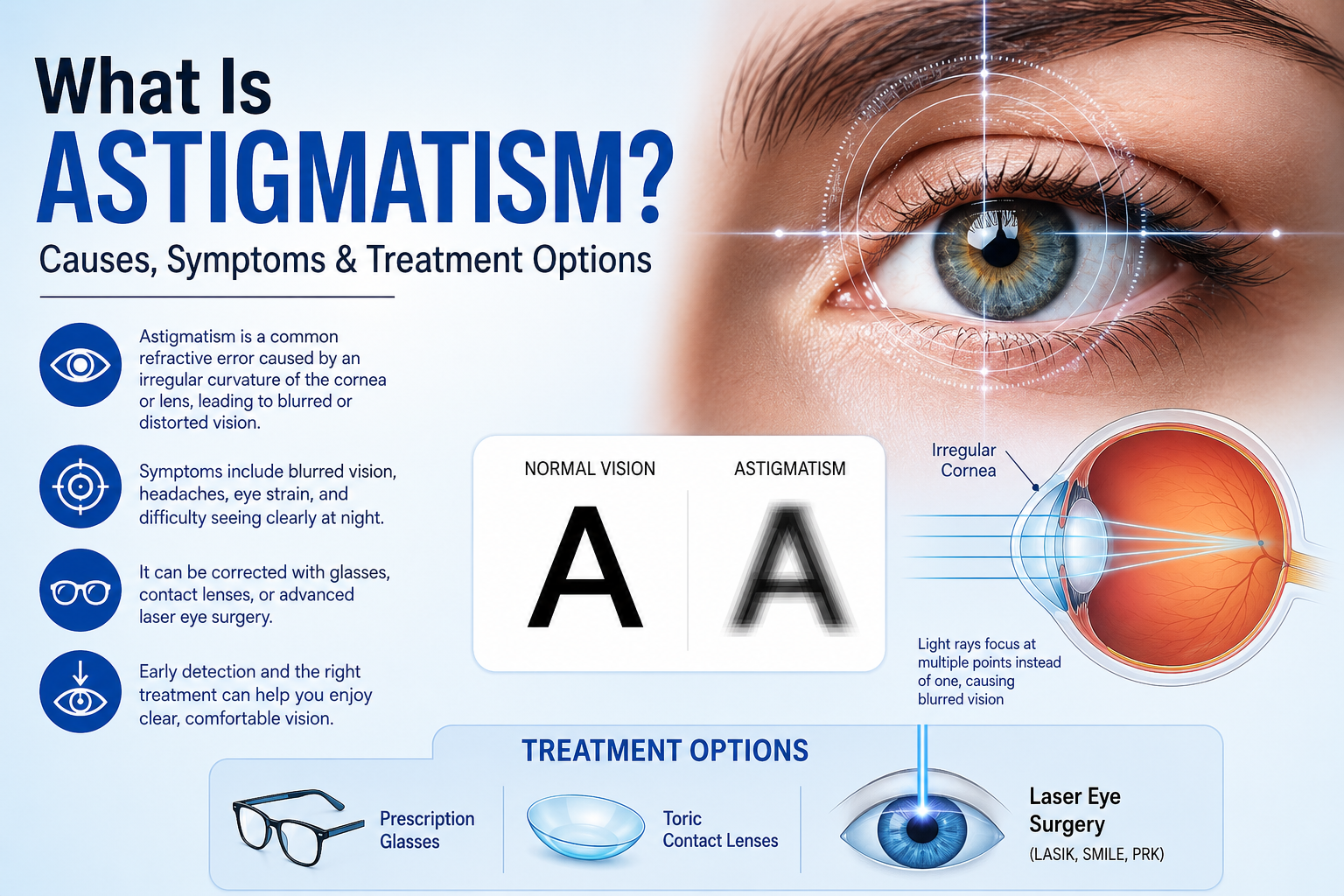
Astigmatism is a common refractive error that can cause blurred, distorted, or stretched vision at both near and far distances. It occurs when the cornea or, less commonly, the lens has an irregular curvature, preventing light from focusing at a single point on the retina.
Unlike a perfectly spherical cornea, an astigmatic cornea has different curvatures in different meridians. As a result, light rays do not converge to one precise focal point.
Astigmatism can occur alone or together with myopia, hypermetropia, or presbyopia. Mild astigmatism may produce few symptoms, while higher amounts can significantly affect visual clarity.
Early diagnosis and appropriate correction can improve visual quality and, in children, help prevent complications such as amblyopia.
What Is Astigmatism?
Astigmatism is a refractive error caused by unequal optical power in different meridians of the eye.
In a normal eye:
Cornea + Lens → Light focuses at one point on the retina → Clear image
In astigmatism:
Different meridians have different powers → Light forms two focal lines/areas → Blurred or distorted image
The most common form is corneal astigmatism, where the cornea has different curvatures along different meridians.
Normal Eye vs Astigmatic Eye
Normal Eye
The cornea is approximately spherical, with similar curvature in different meridians.
Light entering the eye is focused approximately at a single point on the retina.
Astigmatic Eye
The cornea or crystalline lens has different curvatures in different meridians.
Consequently:
- One meridian may be steeper.
- Another may be flatter.
- The two principal meridians have different refractive powers.
- Light does not form a single retinal point focus.
This produces the characteristic optical phenomenon known as the interval of Sturm.
Causes of Astigmatism
Astigmatism can develop due to several factors.
1. Corneal Curvature
The most common cause is an irregular or non-spherical corneal curvature.
Instead of being approximately equally curved in all directions, the cornea may be:
- Steeper vertically
- Flatter horizontally
or have another pattern of unequal curvature.
2. Lenticular Astigmatism
Astigmatism can also originate from the crystalline lens.
This is known as lenticular astigmatism.
Possible causes include:
- Abnormal lens curvature
- Lens position
- Lens tilt
- Certain lens abnormalities
3. Genetics
Astigmatism may run in families.
Children with a family history of refractive errors may have an increased likelihood of developing astigmatism.
4. Eye Injury
Corneal trauma can alter corneal shape and produce astigmatism.
For example:
- Corneal scars
- Surgical wounds
- Traumatic injuries
may change the regularity of the cornea.
5. Eye Surgery
Certain ocular surgeries can alter corneal curvature.
Postoperative astigmatism may occur after procedures such as:
- Cataract surgery
- Corneal surgery
- Some other anterior-segment procedures
6. Keratoconus
Keratoconus is a progressive corneal disorder in which the cornea becomes thinner and more cone-shaped.
It can produce:
- Increasing astigmatism
- Irregular astigmatism
- Distorted vision
- Frequent prescription changes
Significant or rapidly changing astigmatism should therefore be evaluated carefully.
Risk Factors for Astigmatism
Factors associated with astigmatism include:
- Family history
- Congenital corneal shape
- Keratoconus
- Corneal injury
- Corneal surgery
- Certain eye diseases
- Abnormal eyelid pressure in some individuals
Astigmatism may be present from childhood or develop later in life.
Symptoms of Astigmatism
Symptoms vary according to the amount and type of astigmatism.
Common symptoms include:
- Blurred vision
- Distorted vision
- Difficulty seeing fine details
- Headaches
- Eye strain
- Squinting
- Difficulty seeing clearly at night
- Difficulty reading
- Visual fatigue
- Frequent changes in spectacle prescription
Astigmatism and Blurred Vision
Astigmatism can blur vision at both:
Distance
Patients may have difficulty seeing:
- Road signs
- Classroom boards
- Television
- Faces at a distance
Near
Patients may experience difficulty with:
- Reading
- Computer work
- Fine visual tasks
The degree of blur depends on the amount and orientation of astigmatism.
Astigmatism and Headaches
Uncorrected astigmatism can cause visual strain.
Patients may experience headaches particularly after:
- Reading
- Studying
- Computer work
- Prolonged near tasks
However, headaches can have many causes, so astigmatism should not automatically be assumed to be responsible.
Types of Astigmatism
Astigmatism can be classified in several ways.
1. Regular Astigmatism
In regular astigmatism, the two principal meridians are approximately perpendicular to each other.
This is the most common type.
Regular astigmatism can generally be corrected effectively using:
- Cylindrical spectacle lenses
- Toric contact lenses
- Appropriate refractive surgery
2. Irregular Astigmatism
In irregular astigmatism, the principal meridians are not uniformly perpendicular or the corneal curvature changes irregularly across the surface.
Causes include:
- Keratoconus
- Corneal scars
- Corneal trauma
- Certain corneal surgeries
Irregular astigmatism can be more difficult to correct using ordinary spectacle lenses.
Specialized contact lenses may provide better visual rehabilitation in selected patients.
Types Based on the Principal Meridian
Regular astigmatism can also be classified according to the orientation of its principal meridians.
With-the-Rule Astigmatism
The vertical meridian is steeper than the horizontal meridian.
It is commonly associated with:
- Younger individuals
- Childhood astigmatism
Against-the-Rule Astigmatism
The horizontal meridian is steeper than the vertical meridian.
It becomes more common with increasing age.
Oblique Astigmatism
The principal meridians are oriented obliquely rather than approximately vertical and horizontal.
The axes are typically away from the conventional 90° and 180° orientations.
Classification According to Refractive Error
Astigmatism can also be classified according to whether the focal lines lie in front of or behind the retina.
Simple Myopic Astigmatism
One principal meridian is myopic while the other is emmetropic.
Compound Myopic Astigmatism
Both principal meridians are myopic but have different powers.
Simple Hypermetropic Astigmatism
One principal meridian is hypermetropic while the other is emmetropic.
Compound Hypermetropic Astigmatism
Both principal meridians are hypermetropic but have different powers.
Mixed Astigmatism
One principal meridian is myopic and the other is hypermetropic.
This produces focal lines on opposite sides of the retina.
Astigmatism vs Myopia
These two refractive errors are different.
Myopia
The eye has excessive optical power or excessive axial length, causing light to focus in front of the retina.
Astigmatism
Different meridians have different optical powers, producing different focal positions.
A patient can have:
Myopia + Astigmatism
This is extremely common.
Astigmatism vs Hypermetropia
Hypermetropia occurs when the optical system focuses light behind the retina when accommodation is relaxed.
Astigmatism involves unequal power between different meridians.
A person can also have:
Hypermetropia + Astigmatism
How Is Astigmatism Diagnosed?
A comprehensive eye examination can identify astigmatism.
Important tests include:
- Visual acuity testing
- Retinoscopy
- Autorefraction
- Keratometry
- Subjective refraction
- Jackson cross-cylinder testing
- Corneal topography
- Corneal tomography
1. Visual Acuity Test
Visual acuity is measured using an eye chart.
Uncorrected visual acuity may be reduced when significant astigmatism is present.
Best-corrected visual acuity is also important.
2. Retinoscopy
Retinoscopy is an objective method of determining refractive error.
It can provide information about:
- Sphere
- Cylinder
- Axis
The examiner observes the retinal reflex while introducing lenses.
3. Autorefraction
An autorefractor provides an automated estimate of refractive error.
It can provide:
- Spherical power
- Cylinder power
- Cylinder axis
However, subjective refinement is often necessary.
4. Keratometry
Keratometry measures the curvature of the central cornea.
It provides information about:
- Steep meridian
- Flat meridian
- Corneal astigmatism
It is particularly useful when evaluating corneal astigmatism and fitting certain contact lenses.
5. Subjective Refraction
Subjective refraction determines the prescription that provides the best visual performance.
The clinician evaluates:
- Sphere
- Cylinder
- Axis
The patient provides responses regarding clarity during the testing process.
6. Jackson Cross Cylinder (JCC)
The Jackson Cross Cylinder, commonly called JCC, is an important tool for refining astigmatism.
It is used to refine:
- Cylinder axis
- Cylinder power
A useful clinical sequence is:
Determine sphere → Refine cylinder axis → Refine cylinder power → Recheck sphere → Verify visual acuity
7. Corneal Topography
Corneal topography creates a detailed map of corneal curvature.
It can help identify:
- Regular astigmatism
- Irregular astigmatism
- Keratoconus
- Corneal surface abnormalities
8. Corneal Tomography
Corneal tomography provides additional information about the anterior and posterior corneal surfaces and corneal thickness distribution.
It is particularly useful when irregular astigmatism or corneal ectatic disorders are suspected.
Understanding Cylinder Power and Axis
Astigmatic prescriptions contain two important components:
Cylinder Power
Indicates the amount of difference in refractive power between the principal meridians.
Axis
Indicates the orientation of the cylinder.
The axis is expressed in degrees from:
0° to 180°
The axis does not represent the amount of cylinder power.
Why Does Astigmatism Require Axis Correction?
A cylindrical lens has its optical effect oriented along a specific meridian.
If the axis is incorrect:
- The correct amount of cylinder may still produce blurred vision.
- Visual clarity may not reach its maximum.
- The patient may experience visual discomfort.
Therefore, both cylinder power and cylinder axis must be appropriately determined.
Treatment of Astigmatism
The treatment depends on:
- Amount of astigmatism
- Regularity of the cornea
- Age
- Symptoms
- Visual requirements
- Associated eye conditions
Main options include:
- Spectacles
- Contact lenses
- Refractive surgery
- Treatment of underlying corneal disease
1. Spectacles
Spectacles are the most common treatment for regular astigmatism.
Cylindrical or sphero-cylindrical lenses compensate for the difference in refractive power between the principal meridians.
Advantages
- Safe
- Non-invasive
- Easy to use
- Suitable for children
- Affordable
2. Toric Contact Lenses
Toric contact lenses are designed to correct astigmatism.
Unlike spherical contact lenses, toric lenses have different powers in different meridians.
They must maintain the correct rotational orientation on the eye.
Types include:
- Soft toric lenses
- Rigid gas-permeable lenses
- Specialty lenses
3. Rigid Gas-Permeable Lenses
RGP lenses can be particularly useful for certain forms of irregular astigmatism.
The rigid optical surface can create a more regular refracting surface in front of an irregular cornea.
They may be considered for conditions such as:
- Keratoconus
- Corneal scars
- Irregular corneal surfaces
4. Refractive Surgery
Selected patients may undergo refractive surgery to reduce astigmatism.
Common procedures include:
LASIK
Laser reshaping of the cornea.
PRK
Surface laser treatment without creation of a conventional LASIK flap.
SMILE
A minimally invasive corneal procedure that can correct suitable forms of myopia and astigmatism depending on the procedure and available technology.
Not every patient is a suitable candidate.
5. Treatment of Underlying Corneal Disease
If astigmatism is caused by a corneal disorder, treating the underlying condition is essential.
For example, patients with keratoconus may require:
- Corneal cross-linking
- Specialty contact lenses
- Intracorneal ring segments in selected cases
- Corneal transplantation in advanced disease
The treatment depends on disease severity.
Astigmatism in Children
Astigmatism is particularly important in children because significant uncorrected refractive error can interfere with normal visual development.
Persistent blurred retinal images during childhood may contribute to amblyopia.
Children should therefore receive appropriate vision screening and comprehensive eye examinations when indicated.
Astigmatism and Amblyopia
Amblyopia, sometimes called lazy eye, is reduced visual development that cannot be explained solely by a current ocular structural abnormality.
Significant uncorrected astigmatism during the critical period of visual development can contribute to meridional amblyopia.
Early correction is therefore particularly important in children.
Astigmatism and Keratoconus
A rapidly changing or increasingly irregular astigmatic prescription may indicate an underlying corneal condition.
Keratoconus can cause:
- Increasing cylinder
- Increasing myopia
- Irregular astigmatism
- Reduced best-corrected visual acuity
- Frequent prescription changes
Corneal topography or tomography can help evaluate suspected cases.
Can Astigmatism Get Worse?
Astigmatism can change over time.
Changes may occur due to:
- Normal ocular development
- Aging
- Corneal disease
- Eye injury
- Surgery
- Changes in the crystalline lens
Rapid or unusual changes warrant a comprehensive eye examination.
Can Astigmatism Be Prevented?
Most common forms of astigmatism cannot be completely prevented because corneal shape is influenced by genetics and ocular development.
However, certain acquired causes may be reduced by:
- Protecting the eyes from injury
- Managing underlying corneal diseases
- Following appropriate postoperative care
Regular eye examinations can help detect changes early.
Astigmatism and Night Vision
People with uncorrected astigmatism may experience increased difficulty at night.
Symptoms can include:
- Halos
- Glare
- Blurred lights
- Starburst patterns
- Difficulty driving at night
Correcting the cylinder and axis can improve visual quality in many patients.
Frequently Asked Questions About Astigmatism
What is the main cause of astigmatism?
The most common cause is unequal curvature of the cornea in different meridians.
Can astigmatism be cured?
Astigmatism can often be effectively corrected. Depending on the cause and patient, correction may involve spectacles, contact lenses, or refractive surgery.
Can I wear contact lenses if I have astigmatism?
Yes. Toric soft contact lenses and rigid gas-permeable lenses can correct many forms of astigmatism.
Is astigmatism common in children?
Yes. Astigmatism can occur in children and should be corrected appropriately when clinically significant to support normal visual development.
Does astigmatism cause headaches?
Uncorrected astigmatism can contribute to eye strain and headaches, particularly during prolonged visual tasks, although headaches have many possible causes.
Can LASIK correct astigmatism?
Yes, suitable forms and amounts of astigmatism can be corrected with laser refractive procedures in appropriately selected patients.
What is the difference between cylinder and axis?
Cylinder indicates the amount of astigmatic power, while axis indicates its orientation from 0° to 180°.
Key Takeaways
- Astigmatism is a common refractive error caused by unequal optical power in different meridians.
- The cornea is the most common source of astigmatism.
- Symptoms include blurred or distorted vision, eye strain, headaches, and difficulty with night vision.
- Astigmatism can be regular or irregular.
- Regular astigmatism can often be corrected with spectacles or toric contact lenses.
- Irregular astigmatism may require specialty contact lenses or treatment of an underlying corneal disorder.
- Retinoscopy, subjective refraction, keratometry, JCC, corneal topography, and tomography can help diagnose and characterize astigmatism.
- Cylinder power and axis are both essential components of an astigmatic prescription.
- Significant astigmatism in children should be identified and corrected early to reduce the risk of amblyopia.
- Rapidly changing or irregular astigmatism may warrant evaluation for conditions such as keratoconus.
Conclusion
Astigmatism is a common and generally manageable refractive error resulting from unequal curvature or optical power in different meridians of the eye. It can cause blurred and distorted vision at both distance and near and may be associated with eye strain, headaches, and night-vision difficulties.
Accurate diagnosis requires more than simply measuring visual acuity. Retinoscopy, subjective refraction, keratometry, Jackson cross-cylinder testing, corneal topography, and corneal tomography can help determine the type and severity of astigmatism.
For most patients with regular astigmatism, cylindrical spectacles or toric contact lenses provide effective correction. Selected patients may also benefit from refractive surgery. Children require particular attention because significant uncorrected astigmatism can interfere with visual development and contribute to amblyopia.
Understanding the causes, symptoms, types, diagnosis, cylinder power, axis, and treatment options is essential for effective clinical management and long-term visual health.
By Unknown Author
Status: Published