
Blog Details
How to Measure Pupillary Distance at Home
How to Measure Pupillary Distance at Home
Primary Keywords: how to measure pupillary distance, measure PD at home
Secondary Keywords: pupillary distance measurement, how to measure PD, PD measurement at home, measure pupillary distance for glasses, distance PD, near PD, DIY pupillary distance
Title: How to Measure Pupillary Distance at Home: Step-by-Step Guide (2026)
Description: Learn how to measure pupillary distance (PD) at home accurately using a ruler, mirror, smartphone apps, or a helper. Follow this step-by-step guide to get the correct PD for prescription glasses.
Introduction
Ordering prescription glasses online has become more convenient than ever. However, one essential measurement is often overlooked—Pupillary Distance (PD). Even if your eyeglass prescription is accurate, an incorrect PD measurement can result in blurry vision, headaches, eye strain, and uncomfortable glasses.
Fortunately, you can measure pupillary distance (PD) at home using simple tools if you follow the correct technique. While professional measurements remain the gold standard, home methods can provide a reasonably accurate estimate for many people, especially when purchasing single-vision glasses.
In this comprehensive guide, you'll learn how to measure pupillary distance at home, the tools you'll need, different measurement methods, how smartphone apps work, common mistakes to avoid, and when you should seek professional measurement.
What Is Pupillary Distance (PD)?
Pupillary Distance (PD) is the distance between the centers of your pupils, measured in millimeters (mm).
This measurement tells the optical laboratory exactly where to position the optical centers of your eyeglass lenses. Proper alignment ensures that light passes through the correct portion of the lenses, providing clear, comfortable vision.
An incorrect PD can cause the lenses to act like small prisms, leading to visual discomfort even if your prescription is perfect.
Why Is Accurate PD Measurement Important?
Many people think their spectacle prescription is the only measurement that matters. In reality, PD is equally important.
Accurate PD helps:
- Position the optical center of lenses correctly
- Improve image clarity
- Reduce eye strain
- Prevent headaches
- Improve comfort while reading
- Enhance distance vision
- Improve adaptation to new glasses
The higher your prescription, the more critical PD becomes.
Tools Required to Measure PD at Home
The good news is that you don't need expensive equipment.
Here are the tools commonly used:
1. Millimeter Ruler
A ruler marked in millimeters provides the most accurate manual measurement.
Plastic rulers with fine markings work best.
2. Mirror
A flat mirror allows you to see your eyes while aligning the ruler correctly.
Good lighting is essential.
3. Smartphone Camera
Many online retailers and apps use smartphone cameras to estimate PD.
Some use facial recognition technology to improve accuracy.
4. Another Person
Having someone else measure your PD often improves accuracy because you can keep both eyes open and focus naturally.
5. Good Lighting
Bright lighting makes it easier to locate the exact center of each pupil.
Natural daylight often provides the best results.
Understanding Distance PD and Near PD
Before measuring, it's important to understand that there are two different PD measurements.
Distance PD
Distance PD is measured while looking at a distant object.
Used for:
- Everyday prescription glasses
- Distance vision
- Driving glasses
- Progressive lenses
Near PD
Near PD is measured while focusing on a close object.
It is used for:
- Reading glasses
- Computer glasses
- Occupational lenses
Near PD is usually 2–4 mm smaller than distance PD because the eyes naturally move inward (converge) when looking at close objects.
Method 1: Measuring PD Using a Mirror
This is the most common DIY method.
Step 1: Gather Your Materials
You'll need:
- Millimeter ruler
- Mirror
- Bright lighting
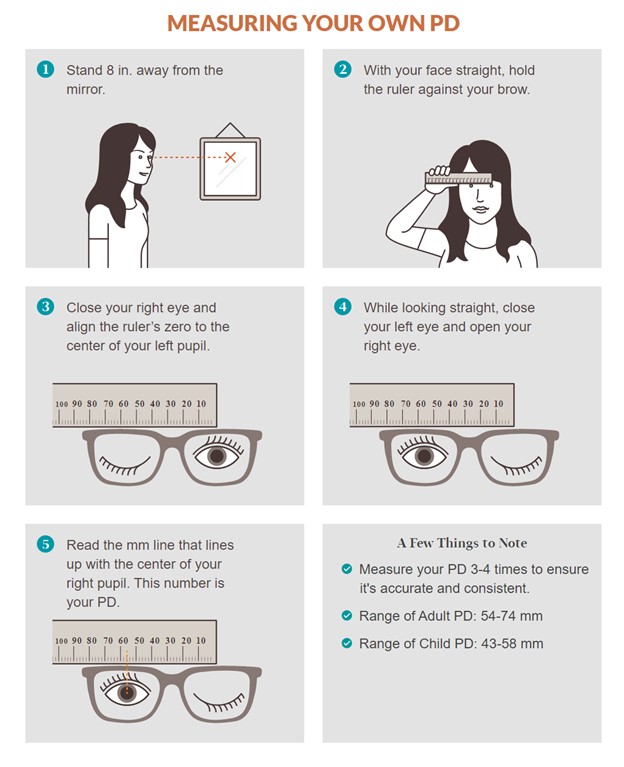
Step 2: Stand in Front of the Mirror
Stand approximately 20 cm (8 inches) from the mirror.
Keep your head straight.
Avoid tilting your face.
Step 3: Hold the Ruler
Place the ruler across the bridge of your nose.
The ruler should remain horizontal.
Step 4: Close One Eye
Close your right eye.
Look directly into your left pupil.
Align the zero mark of the ruler with the center of your left pupil.
Step 5: Open Both Eyes
Without moving the ruler:
- Open your right eye.
- Close your left eye.
Read the millimeter marking directly over the center of your right pupil.
This number is your distance PD.
Example:
Left pupil = 0 mm
Right pupil = 64 mm
Your PD = 64 mm
Step 6: Repeat Several Times
Measure your PD at least three times.
If the values are consistent, average them.
Repeated measurements improve reliability.
Method 2: Measuring PD with Another Person
This method often produces better results.
Step 1
Sit comfortably.
Look at a distant object approximately 3–6 meters (10–20 feet) away.
Do not look at the ruler.
Step 2
The helper places the ruler across your nose.
Step 3
They align zero with the center of one pupil.
Step 4
Without moving the ruler, they read the distance to the center of the opposite pupil.
Step 5
Repeat the measurement several times.
If repeated measurements differ, use the average.
Method 3: Measuring Monocular PD
Some prescriptions require separate measurements for each eye.
This is called Monocular PD.
Example:
Right PD = 32 mm
Left PD = 33 mm
Recorded as:
32/33 mm
Monocular PD is especially important for:
- Progressive lenses
- High prescriptions
- Prism lenses
- Patients with facial asymmetry
Method 4: Measuring Near PD
Near PD differs slightly from distance PD.
To measure near PD:
- Hold a reading card approximately 40 cm (16 inches) away.
- Focus on the card.
- Repeat the same ruler measurement process.
Because your eyes converge, near PD will usually be slightly smaller.
Measuring PD with Smartphone Apps
Modern smartphone apps have made home PD measurement easier than ever.
These apps typically use:
- Facial recognition
- Camera calibration
- Artificial intelligence
- Reference objects such as a bank card
Popular features include:
- Automatic pupil detection
- Distance PD calculation
- Near PD estimation
- Monocular PD measurement
- Data storage for future orders
Advantages
- Fast
- Convenient
- No ruler required
- Useful for online eyewear shopping
Limitations
Accuracy depends on:
- Camera quality
- Lighting
- User positioning
- Calibration
- Software algorithms
For simple single-vision glasses, many apps provide acceptable estimates. However, they may not match the precision of professional instruments.
Tips for More Accurate Home PD Measurements
Improve accuracy by following these recommendations:
- Measure in bright lighting.
- Keep your head level.
- Look straight ahead.
- Do not move the ruler.
- Repeat the measurement several times.
- Average multiple readings.
- Ask another person for assistance if possible.
- Use a ruler marked in millimeters.
- Avoid measuring when tired.
Common Mistakes When Measuring PD at Home
Even small errors can affect lens alignment.
Looking at the Ruler
Always focus on a distant object rather than the ruler itself.
Tilting Your Head
A tilted head changes the measurement.
Maintain a natural upright posture.
Using an Inch Ruler
PD should always be measured in millimeters.
Measuring Only Once
Single measurements may contain errors.
Repeat measurements for greater accuracy.
Poor Lighting
Dim lighting makes it difficult to identify the exact center of each pupil.
Measuring While Moving
Keep both your head and ruler steady throughout the process.
Confusing Near PD and Distance PD
These are different measurements and should not be used interchangeably.
Signs Your PD Measurement May Be Incorrect
If your glasses have the correct prescription but the wrong PD, you may experience:
- Blurred vision
- Headaches
- Eye strain
- Difficulty focusing
- Double vision
- Dizziness
- Motion sickness
- Distorted peripheral vision
- Difficulty adapting to new glasses
If these symptoms occur, have your PD rechecked by an eye care professional.
Can Children Measure PD at Home?
Parents can estimate a child's PD at home, but children often have difficulty keeping their eyes still during measurement.
Because children's facial anatomy changes as they grow, professional measurements are generally recommended for pediatric eyewear.
When to Seek Professional PD Measurement
Although home methods are convenient, professional measurement is recommended in many situations.
Seek professional measurement if you:
- Have a high prescription (typically above ±4.00 D)
- Are ordering progressive or multifocal lenses
- Need prism correction
- Have significant facial asymmetry
- Experience persistent headaches with new glasses
- Have previously received poorly fitting eyewear
- Are purchasing expensive prescription lenses
- Need highly precise optical alignment
Optometrists and opticians use digital pupillometers and specialized fitting equipment to provide the most accurate measurements.
Why Professional Measurement Is More Accurate
Professionals use advanced instruments that can measure:
- Distance PD
- Near PD
- Monocular PD
- Fitting height
- Vertex distance
- Pantoscopic tilt
- Optical center alignment
These additional measurements are especially important for premium and progressive lenses, ensuring optimal visual performance.
Frequently Asked Questions
Can I measure my own PD accurately?
Yes. With a millimeter ruler, proper technique, and repeated measurements, many adults can obtain a reasonably accurate estimate for single-vision glasses.
How many times should I measure my PD?
Measure at least three times and use the average if the results are consistent.
Is a smartphone app accurate enough?
Many apps provide a good estimate, but professional measurements are generally more accurate, particularly for complex prescriptions.
Why is my near PD smaller than my distance PD?
When focusing on close objects, the eyes naturally converge inward, reducing the distance between the pupils.
Can an incorrect PD damage my eyes?
An incorrect PD does not permanently damage the eyes, but it can cause blurred vision, headaches, eye strain, dizziness, and difficulty adapting to new glasses.
Conclusion
Learning how to measure pupillary distance (PD) at home is a useful skill, especially when ordering prescription glasses online. With a millimeter ruler, a mirror, good lighting, or a reliable smartphone app, many people can obtain an accurate estimate for standard eyewear.
However, while home measurements are convenient, they may not provide the precision required for high prescriptions, progressive lenses, prism corrections, or pediatric eyewear. In these cases, professional measurement by an optometrist or optician remains the safest and most reliable option.
By taking the time to measure your PD correctly and avoiding common mistakes, you can improve the fit of your glasses, enhance visual clarity, and reduce discomfort—ensuring your eyewear delivers the best possible vision every day.
By Unknown Author
Status: Published