
Introduction
Hypermetropia correction, also known as hyperopia correction, aims to improve vision by compensating for the eye's insufficient optical power. In hypermetropia, light rays would focus behind the retina when accommodation is relaxed. This can make near vision difficult and, in higher degrees of hyperopia, may affect distance vision as well.
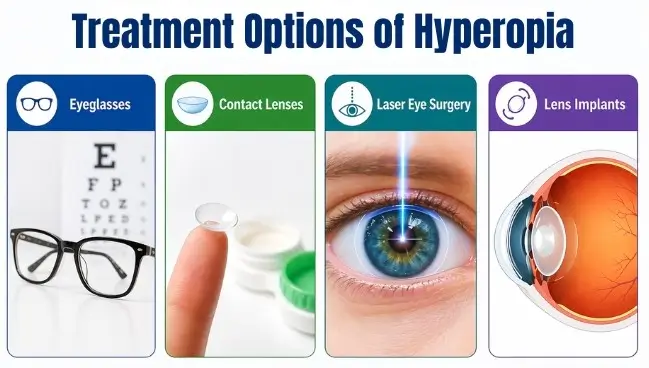
The most common method of correcting hypermetropia is with plus-powered convex lenses. Depending on age, refractive error, lifestyle, ocular health, and personal preference, contact lenses may also be considered. Selected adults with stable refractive errors may be candidates for refractive surgery.
This guide explains the major methods of hypermetropia correction, how each works, their advantages and limitations, and important clinical considerations.
What Is Hypermetropia?
Hypermetropia is a refractive error in which the eye does not have sufficient converging power relative to its axial length.
When accommodation is relaxed:
Parallel light rays → Eye → Focus behind retina
Because the focus lies behind the retinal plane, the retinal image may be blurred.
A young person can sometimes compensate by accommodating.
Basic concept
Hypermetropia → Focus behind retina
Plus lens → Adds converging power
Corrected focus → Moves toward retina
Why Does Hypermetropia Need Correction?
Mild hypermetropia may not always require correction, particularly in children who have normal visual development and no symptoms.
However, significant hypermetropia may cause:
- Blurred vision
- Eye strain
- Headaches
- Difficulty with prolonged near work
- Reading discomfort
- Visual fatigue
- Reduced visual performance
- Accommodative problems
In children, significant uncorrected hyperopia may also be associated with:
- Amblyopia
- Accommodative esotropia
- Reduced binocular visual function
Therefore, the decision to correct hypermetropia depends on the individual clinical situation.
How Is Hypermetropia Corrected?
The main options include:
- Convex spectacle lenses
- Contact lenses
- Refractive surgery in selected adults
The appropriate option depends on the patient's:
- Age
- Degree of hyperopia
- Visual needs
- Symptoms
- Corneal anatomy
- Ocular health
- Refractive stability
- Personal preference
1. Convex Lenses for Hypermetropia
Plus-powered convex lenses are the standard and most common method of correcting hypermetropia.
A convex lens is thicker centrally than at the edges and provides positive optical power.
How Does a Convex Lens Correct Hypermetropia?
The hyperopic eye tends to focus incoming light behind the retina.
A convex lens begins converging the incoming rays before they enter the eye.
Without correction:
Parallel rays → Hyperopic eye → Focus behind retina
With a plus lens:
Parallel rays → Convex lens → Converging rays → Eye → Focus on retina
Therefore, the convex lens supplies additional optical power that the eye lacks.
Why Is a Plus Lens Used?
This is a fundamental refractive principle:
Hypermetropia → Plus lens
Myopia → Minus lens
A plus lens has positive refractive power and helps shift the focal position forward toward the retina.
Types of Spectacle Lenses for Hypermetropia
Depending on the patient's needs, different spectacle designs can be used.
Single-Vision Lenses
Single-vision lenses provide one optical power throughout the lens.
They may be prescribed for:
- Distance vision
- Near vision
- General visual correction
Bifocal Lenses
Bifocal lenses contain two optical zones.
They may be useful for patients who require:
- Distance correction
- Near addition
This can become relevant in older hyperopic patients who also develop presbyopia.
Progressive Addition Lenses
Progressive lenses provide a gradual change in power from distance to near without a visible dividing line.
They may be considered for patients with hypermetropia and age-related loss of accommodation.
High-Plus Spectacle Lenses
Higher hyperopic prescriptions require stronger plus lenses.
High-powered plus lenses can produce optical effects such as:
- Magnification
- Increased lens thickness
- Cosmetic concerns
- Distortion toward the lens periphery
Modern lens materials and designs can help reduce some of these effects.
Aspheric Lenses for Hypermetropia
Aspheric lens designs can be useful for higher prescriptions.
They can help reduce:
- Lens thickness
- Bulging appearance
- Peripheral optical aberrations
- Cosmetic concerns
The suitability depends on the prescription and individual visual requirements.
Advantages of Spectacle Correction
Spectacles have several advantages:
- Non-invasive
- Easy to use
- No direct contact with the eye
- Generally low maintenance
- Available in many lens designs
- Easy to remove
- Suitable for children and adults
For many patients, spectacles remain the simplest and safest method of hypermetropia correction.
Limitations of Spectacles
Potential limitations include:
- Lens magnification with higher plus powers
- Frame-related discomfort
- Fogging
- Cosmetic concerns
- Peripheral distortion
- Restrictions during some sports or activities
These limitations may lead some patients to consider contact lenses.
2. Contact Lenses for Hypermetropia
Contact lenses provide refractive correction directly on the eye.
They can be used to correct hyperopic refractive errors in appropriately selected patients.
Instead of placing the corrective lens several millimeters in front of the eye, the contact lens sits on the cornea and moves with the eye.
How Do Contact Lenses Correct Hypermetropia?
The contact lens provides the required positive optical power at the corneal plane.
Basic principle:
Hyperopic refractive error → Plus-powered contact lens → Corrected retinal focus
Contact lenses can also reduce some of the image-size differences associated with high-powered spectacles.
Types of Contact Lenses for Hypermetropia
Depending on the patient's needs, options may include:
- Soft spherical contact lenses
- Silicone hydrogel lenses
- Rigid gas-permeable lenses in selected cases
- Toric lenses when hyperopia is accompanied by astigmatism
- Multifocal contact lenses for appropriate presbyopic patients
The exact lens type should be determined through professional fitting and assessment.
Advantages of Contact Lenses
Contact lenses can provide:
- Wider field of view — Because the lens moves with the eye, the patient may experience a more natural visual field than with spectacles.
- Less image magnification — High-plus spectacles can magnify retinal images. Contact lenses generally produce less spectacle-related magnification.
- Better cosmetic appearance — There is no visible spectacle frame or thick lens.
- Useful for active lifestyles — Contact lenses may be convenient for sports and other activities where spectacles can be inconvenient.
Limitations of Contact Lenses
Contact lenses require more care than spectacles.
Potential problems include:
- Dryness
- Discomfort
- Poor lens fit
- Allergic or inflammatory reactions
- Corneal complications
- Infection if hygiene is inadequate
Good lens hygiene and appropriate wearing schedules are essential.
Contact Lens Hygiene
Important precautions include:
- Wash hands before handling lenses.
- Follow the recommended replacement schedule.
- Use appropriate lens-care products.
- Avoid using tap water on lenses.
- Do not share contact lenses.
- Follow the prescribed wearing schedule.
- Attend follow-up examinations as recommended.
Contact lens users should seek professional evaluation if they develop significant pain, redness, photophobia, discharge, or sudden visual changes.
Hypermetropia and High Refractive Errors
Contact lenses can be particularly useful in some patients with high hyperopic prescriptions.
High-plus spectacles may cause greater magnification and thickness.
A contact lens sits much closer to the eye's optical system, which can reduce some of these spectacle-related effects.
However, contact lenses are not automatically superior for every high hyperopic patient.
Hypermetropia With Astigmatism
Some patients have both:
Hypermetropia + Astigmatism
This may require:
Sphere + Cylinder + Axis
Depending on the degree of astigmatism, options can include:
- Spectacles
- Toric contact lenses
- Refractive surgery in selected adults
Accurate refraction is essential before deciding on correction.
3. Refractive Surgery for Hypermetropia
Refractive surgery aims to permanently alter the shape or optical properties of the cornea to reduce dependence on spectacles or contact lenses.
Possible procedures for selected hyperopic patients include:
- Hyperopic LASIK
- PRK
- Other corneal refractive procedures in appropriately selected cases
Not every person with hypermetropia is a suitable candidate for refractive surgery.
Hyperopic LASIK
LASIK uses a laser to reshape the cornea.
For hyperopic correction, the procedure aims to increase the effective central corneal power so that incoming light focuses closer to the retinal plane.
Simplified concept:
Hyperopia → Focus behind retina
↓
Corneal reshaping
↓
Increased effective optical power
↓
Focus moves toward retina
How Does Hyperopic LASIK Work?
The exact surgical technique varies, but the general principle involves reshaping the cornea so that its optical power is increased in the desired pattern.
The treatment is planned according to measurements such as:
- Manifest refraction
- Cycloplegic refraction when appropriate
- Corneal topography
- Corneal tomography
- Corneal thickness
- Ocular surface status
PRK for Hypermetropia
Photorefractive keratectomy (PRK) is another corneal laser procedure.
Unlike LASIK, PRK does not create a conventional corneal flap.
The corneal surface layer is removed or displaced according to the technique, and an excimer laser reshapes the underlying corneal tissue.
PRK may be considered in selected patients depending on corneal characteristics and other factors.
LASIK vs PRK for Hypermetropia
| Feature | Hyperopic LASIK | Hyperopic PRK |
|---|---|---|
| Corneal flap | Yes | No conventional flap |
| Laser reshaping | Yes | Yes |
| Initial recovery | Usually faster | Usually slower |
| Surface healing | Less prominent initially | Required |
| Candidate selection | Individualized | Individualized |
| Long-term outcome | Depends on patient and procedure | Depends on patient and procedure |
The choice between procedures requires a comprehensive refractive and corneal evaluation.
Who May Be Considered for Hyperopic Refractive Surgery?
Potential candidates generally need to be carefully evaluated for:
- Stable refractive error
- Appropriate age
- Healthy cornea
- Adequate corneal thickness
- Acceptable corneal topography/tomography
- Healthy ocular surface
- Absence of significant contraindications
- Realistic expectations
The exact eligibility criteria vary by procedure and surgeon.
Who May Not Be a Good Candidate?
Refractive surgery may be inappropriate or require additional consideration in patients with certain conditions, such as:
- Unstable refraction
- Significant corneal disease
- Keratoconus or suspicious corneal topography
- Severe dry eye
- Certain ocular diseases
- Inadequate corneal tissue
- Unrealistic expectations
A detailed preoperative assessment is essential.
Why Is Corneal Topography Important Before Surgery?
Corneal topography and tomography help evaluate the shape and structure of the cornea.
They can identify abnormalities that may increase surgical risk.
This is especially important when evaluating patients for laser refractive surgery.
Hypermetropia and Age
Age is an important consideration when choosing a correction method.
Children
Management focuses primarily on:
- Visual development
- Amblyopia prevention
- Binocular function
- Appropriate refractive correction
Spectacles are commonly used when correction is indicated.
Young Adults
Options may include:
- Spectacles
- Contact lenses
- Refractive surgery after appropriate evaluation
Older Adults
Presbyopia becomes an additional consideration.
The patient may need:
- Distance correction
- Near correction
- Bifocals
- Progressive lenses
- Multifocal contact lenses
Hypermetropia and Presbyopia
Hypermetropia and presbyopia are different conditions.
Hypermetropia
A refractive error caused by the relationship between the eye's optical power and axial length.
Presbyopia
An age-related reduction in accommodation.
However, they can interact.
A hyperopic person may become symptomatic earlier when accommodation decreases with age because some accommodative reserve was already being used to compensate for hyperopia.
Why Some Hyperopic Patients Need Plus Lenses Earlier
A young hyperopic patient may compensate using accommodation.
As accommodation decreases with age:
Accommodation decreases → Compensation decreases → Hyperopia becomes more noticeable
This can result in increasing difficulty with near tasks.
Hypermetropia Correction in Children
Children require special consideration.
A refractive prescription should not be based solely on the largest measured hyperopic value.
The clinician considers:
- Age
- Visual acuity
- Symptoms
- Binocular status
- Ocular alignment
- Amblyopia risk
- Accommodation
- Cycloplegic findings
Some children with mild hyperopia may be observed, while others require optical correction.
Hypermetropia and Amblyopia
Significant uncorrected hyperopia can contribute to amblyopia.
The mechanism is:
Persistent retinal image blur
↓
Abnormal visual development
↓
Reduced visual acuity
Therefore, correcting clinically significant hypermetropia can be an important part of managing amblyopia risk.
Hypermetropia and Accommodative Esotropia
Significant hyperopia can also be associated with accommodative esotropia.
The simplified mechanism is:
Hyperopia → Increased accommodation → Increased accommodative convergence → Inward eye deviation
Appropriate refractive correction can reduce the accommodative demand in children with accommodative esotropia.
How Is the Final Hyperopic Prescription Determined?
The prescription should be based on a comprehensive examination.
A typical assessment may include:
Visual acuity
↓
Objective refraction
↓
Retinoscopy/autorefraction
↓
Cycloplegic refraction when indicated
↓
Subjective refinement
↓
Binocular assessment
↓
Final prescription
The goal is not simply to prescribe the highest plus measurement. The prescription must be clinically appropriate for the individual patient.
Maximum Plus for Maximum Visual Acuity
During subjective refraction, a key principle is:
Maximum plus for maximum visual acuity.
This means finding the maximum appropriate plus power that maintains the best achievable visual acuity under the testing conditions.
This helps avoid unnecessary minus correction in hyperopic patients.
Advantages of Spectacles
- Simple
- Non-invasive
- Easily removable
- Suitable for many ages
- Easy to maintain
- No corneal contact
- Generally cost-effective
Advantages of Contact Lenses
- Wider field of view
- Less spectacle magnification
- Improved cosmetic appearance
- Useful for sports
- Convenient for some high prescriptions
Advantages of Refractive Surgery
For appropriately selected adults, refractive surgery may:
- Reduce dependence on spectacles
- Reduce dependence on contact lenses
- Provide long-term refractive correction
However, surgery does not guarantee perfect vision or eliminate all future need for glasses.
Limitations of Refractive Surgery
Patients should understand that refractive surgery can have risks and limitations.
Potential issues may include:
- Dry eye symptoms
- Glare
- Halos
- Regression of refractive correction
- Residual refractive error
- Under-correction
- Over-correction
- Corneal complications
Rare but serious complications can also occur.
Proper patient selection is therefore critical.
Can Hypermetropia Be Completely Cured?
The word "cure" can be misleading.
Spectacles and contact lenses correct the refractive error while they are being worn.
Refractive surgery can permanently alter corneal shape and reduce dependence on optical correction in selected patients, but it does not guarantee that the eye will never require glasses in the future.
Age-related changes such as presbyopia can still occur.
Does Wearing Plus Glasses Make Hypermetropia Worse?
Properly prescribed plus spectacles do not make the eye structurally weaker or cause hypermetropia to increase simply because the patient wears them.
The glasses provide the optical correction needed to place the image appropriately on the retina.
In children, appropriate correction can be particularly important when significant hyperopia affects visual development.
Frequently Asked Questions
What is the best lens for hypermetropia?
The standard optical correction is a plus-powered convex lens.
Why are convex lenses used for hyperopia?
Convex lenses add positive converging power and help move the focal point forward onto the retina.
Can contact lenses correct hypermetropia?
Yes. Appropriate plus-powered contact lenses can correct hyperopic refractive errors.
Is LASIK possible for hypermetropia?
Selected adults with suitable refractive and corneal characteristics may be candidates for hyperopic LASIK.
Is PRK possible for hyperopia?
PRK can be used for selected hyperopic patients after appropriate assessment.
Which is better: glasses or contact lenses?
Neither is universally better. The choice depends on refractive error, age, ocular health, lifestyle, comfort, and personal preference.
Can children wear contact lenses for hypermetropia?
Selected children and adolescents can use contact lenses, but appropriate maturity, hygiene, fitting, and follow-up are important.
Can hypermetropia be corrected permanently?
Refractive surgery can reduce dependence on spectacles or contact lenses in selected adults, but it does not prevent normal age-related changes such as presbyopia.
Can hypermetropia disappear in children?
Some childhood hyperopia decreases as the eyes develop, but this does not happen in every child.
Key Takeaways
- Hypermetropia correction aims to compensate for the eye's insufficient optical power.
- The standard correction is a plus-powered convex lens.
- Convex lenses add converging power and move the focal point toward the retina.
- Contact lenses provide hyperopic correction directly at the corneal plane.
- Contact lenses can reduce some spectacle-related magnification in high hyperopia.
- Refractive surgery may be an option for carefully selected adults.
- Hyperopic LASIK and PRK reshape the cornea to increase its effective optical power.
- Appropriate surgical candidates require stable refraction and healthy corneas.
- Corneal topography or tomography is important when evaluating patients for refractive surgery.
- Children require special consideration because hyperopia can affect accommodation, amblyopia risk, and ocular alignment.
- Cycloplegic refraction is particularly valuable when accommodation may mask hyperopia.
- Hypermetropia and presbyopia are different, but presbyopia can make previously compensated hyperopia more symptomatic.
- No single correction method is best for everyone.
Conclusion
Hypermetropia correction is based on adding or modifying optical power so that incoming light can be focused appropriately on the retina. For most patients, convex plus-powered spectacles remain the simplest and most widely used treatment.
Contact lenses provide an alternative for patients who prefer not to wear spectacles or who may benefit from reduced spectacle magnification, particularly with higher prescriptions. They require proper fitting, hygiene, and regular follow-up.
For appropriately selected adults, refractive surgery such as hyperopic LASIK or PRK can reduce dependence on spectacles and contact lenses. However, surgical correction requires careful assessment of refractive stability, corneal shape, corneal thickness, ocular surface health, and overall ocular status.
In children, the goal goes beyond simply achieving clear vision. Management must also consider visual development, amblyopia, accommodation, and ocular alignment. Cycloplegic refraction is often particularly important because children's strong accommodation can hide part of the hyperopic refractive error.
The essential clinical principle is:
Hypermetropia → insufficient optical power → plus/convex correction → focal point moves toward the retina.
Choosing between spectacles, contact lenses, and refractive surgery should always be individualized based on the patient's age, refractive error, visual needs, ocular health, and long-term visual goals.