
Blog Details
Myopia: Causes, Symptoms, Types, and Treatment
Myopia: Causes, Symptoms, Types, and Treatment
Introduction
Myopia, commonly known as nearsightedness or short-sightedness, is one of the most common refractive errors affecting millions of people worldwide. Individuals with myopia can see nearby objects clearly, but distant objects appear blurry. The prevalence of myopia has increased significantly over the past few decades, especially among children and young adults, making it a major public health concern.
According to recent studies, nearly half of the world's population may be affected by myopia by 2050. Early diagnosis and proper management are essential to prevent complications and maintain good visual health.
What Is Myopia?
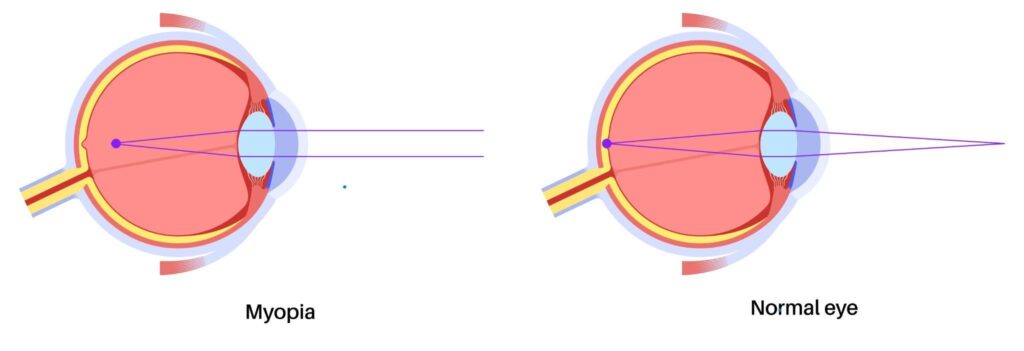
Myopia is a refractive error that occurs when light entering the eye focuses in front of the retina instead of directly on it. This results in blurred distance vision while near vision remains relatively clear.
The condition usually develops during childhood and may progress during the school years before stabilizing in adulthood.
Visualizing Myopia
Anatomy and Optics of Myopia
Normal Eye
In a normal eye (emmetropia):
- Light rays enter the eye.
- The cornea and lens bend (refract) the light.
- The light focuses precisely on the retina.
- A clear image is formed.
Myopic Eye
In myopia:
- The eyeball is too long from front to back.
- Or the cornea is too steeply curved.
- Light focuses before reaching the retina.
- Distant images become blurred.
Causes of Myopia
Myopia develops due to a combination of genetic and environmental factors.
1. Genetic Factors
Family history plays a major role.
Risk increases when:
- One parent is myopic.
- Both parents are myopic.
- There is a strong family history of refractive errors.
Children with myopic parents are more likely to develop myopia at an early age.
2. Excessive Near Work
Modern lifestyles involve prolonged near tasks such as:
- Reading
- Studying
- Smartphone use
- Computer work
- Tablet use
Continuous focusing on near objects may contribute to myopia progression.
3. Reduced Outdoor Activity
Research suggests that spending less time outdoors increases the risk of developing myopia.
Outdoor exposure helps because:
- Natural sunlight stimulates dopamine release in the retina.
- Dopamine slows excessive eye growth.
- Outdoor activities reduce continuous near work.
4. Excessive Axial Length Growth
The most common cause of myopia is an increase in the axial length of the eyeball.
When the eye grows longer than normal:
- Light focuses in front of the retina.
- Distance vision becomes blurred.
5. Corneal and Lens Abnormalities
Myopia may also occur due to:
- Excessive corneal curvature
- Increased lens power
- Keratoconus
- Lens-induced refractive changes
Symptoms of Myopia
Symptoms vary depending on the severity of the condition.
Common Symptoms
- Blurred distance vision
- Difficulty seeing road signs
- Trouble viewing classroom boards
- Squinting to see clearly
- Eye strain
- Headaches
- Frequent blinking
- Difficulty driving at night
Symptoms in Children
Parents should watch for:
- Sitting very close to the television
- Holding books close to the face
- Frequent eye rubbing
- Poor school performance
- Squinting frequently
Early detection is crucial to prevent progression.
Types of Myopia
1. Simple Myopia
The most common form.
Characteristics:
- Usually less than −6.00 D
- Develops during childhood
- Stabilizes in adulthood
- Easily corrected with glasses or contact lenses
2. High Myopia
Defined as:
- Refractive error greater than −6.00 D
- Axial length greater than 26 mm
Features:
- Higher risk of ocular complications
- Greater retinal stretching
- Increased likelihood of vision loss
3. Pathological Myopia
A severe progressive form of high myopia characterized by degenerative changes.
Complications include:
- Myopic maculopathy
- Retinal degeneration
- Choroidal neovascularization
- Retinal detachment
This condition requires lifelong monitoring.
4. Congenital Myopia
Present at birth.
Characteristics:
- Rare
- Often associated with developmental abnormalities
- May lead to amblyopia if untreated
5. Progressive Myopia
Occurs when refractive error continues to increase over time.
Common in:
- School-age children
- Adolescents
Requires active myopia control strategies.
6. Pseudomyopia
Caused by excessive accommodation.
Features:
- Temporary myopic shift
- Common after prolonged near work
- Often improves with cycloplegic refraction
7. Night Myopia
Occurs mainly in dim lighting conditions.
Patients experience:
- Blurred night vision
- Difficulty driving after dark
Risk Factors for Myopia
Several factors increase the likelihood of developing myopia.
Non-Modifiable Factors
- Family history
- Ethnicity
- Age
Modifiable Factors
- Excessive screen time
- Continuous near work
- Lack of outdoor activities
- Poor visual habits
How Is Myopia Diagnosed?
An eye care professional performs a comprehensive eye examination.
Diagnostic Tests
Visual Acuity Test
Measures distance vision using a Snellen chart.
Refraction Test
Determines the exact refractive error.
Retinoscopy
Provides an objective estimate of refractive status.
Cycloplegic Refraction
Especially important in children to eliminate accommodation.
Axial Length Measurement
Useful for monitoring myopia progression.
Fundus Examination
Evaluates retinal health, particularly in high myopia.
Treatment of Myopia
1. Spectacles (Eyeglasses)
The most common treatment.
Concave (Minus) Lenses
These lenses:
- Diverge incoming light rays
- Shift the focal point onto the retina
- Improve distance vision
Advantages:
- Safe
- Affordable
- Easy to use
2. Contact Lenses
An effective alternative to spectacles.
Types include:
- Soft contact lenses
- Silicone hydrogel lenses
- Rigid gas permeable lenses
- Orthokeratology lenses
Benefits:
- Wider field of vision
- Better peripheral optics
- Cosmetic advantages
3. Orthokeratology (Ortho-K)
Special rigid lenses worn overnight.
They:
- Temporarily reshape the cornea
- Provide daytime vision without glasses
- May slow myopia progression in children
4. Myopia Control Treatments
Modern eye care focuses on slowing progression.
Low-Dose Atropine
Widely used in children.
Benefits:
- Slows axial elongation
- Reduces progression rate
Multifocal Contact Lenses
Designed to:
- Correct vision
- Reduce myopia progression
Myopia-Control Spectacle Lenses
Special lens designs help slow eye growth.
5. Refractive Surgery
Suitable for selected adults with stable prescriptions.
LASIK
Uses a laser to reshape the cornea.
PRK
Removes corneal tissue without creating a flap.
SMILE
A minimally invasive laser procedure.
Benefits:
- Reduced dependence on glasses
- Long-term vision correction
Complications of High Myopia
Severe myopia can lead to sight-threatening complications.
Retinal Detachment
The retina separates from underlying tissues.
Symptoms:
- Flashes
- Floaters
- Curtain-like vision loss
Myopic Maculopathy
Degenerative changes affect central vision.
Can cause:
- Distorted vision
- Permanent vision loss
Glaucoma
Highly myopic individuals have an increased risk of glaucoma.
Cataract
Myopic patients may develop cataracts earlier than normal.
Choroidal Neovascularization
Abnormal blood vessel growth beneath the retina can result in severe vision loss.
Prevention of Myopia Progression
Although genetics cannot be changed, progression may be reduced.
Recommended Strategies
- Spend at least 2 hours outdoors daily
- Follow the 20-20-20 rule
- Limit excessive screen time
- Maintain proper reading distance
- Use adequate lighting
- Attend regular eye examinations
When to See an Eye Doctor
Seek professional evaluation if you experience:
- Blurred distance vision
- Frequent headaches
- Difficulty driving
- Rapid changes in prescription
- Sudden flashes or floaters
- Loss of vision
Early treatment can prevent serious complications.
Frequently Asked Questions
Can myopia be cured naturally?
No. Myopia cannot be reversed naturally, but progression may be slowed through lifestyle modifications and myopia control treatments.
Does screen time cause myopia?
Excessive near work and prolonged screen use are associated with increased myopia risk, particularly in children.
Can children outgrow myopia?
Most children do not outgrow myopia. Instead, it often progresses during growth years before stabilizing.
Is LASIK a permanent cure?
LASIK permanently reshapes the cornea, but age-related eye changes may still occur later in life.
Conclusion
Myopia is a common refractive error that causes blurred distance vision due to light focusing in front of the retina. Genetics, excessive near work, reduced outdoor activity, and abnormal eye growth all contribute to its development. With early diagnosis, regular eye examinations, and modern treatment options such as spectacles, contact lenses, myopia control therapies, and refractive surgery, most individuals can achieve excellent visual outcomes. Understanding the causes, symptoms, types, and treatment of myopia is essential for protecting long-term eye health and preventing vision-threatening complications.
By Unknown Author
Status: Published