
Presbyopia After 40: Why Near Vision Becomes Blurry and How to Manage It
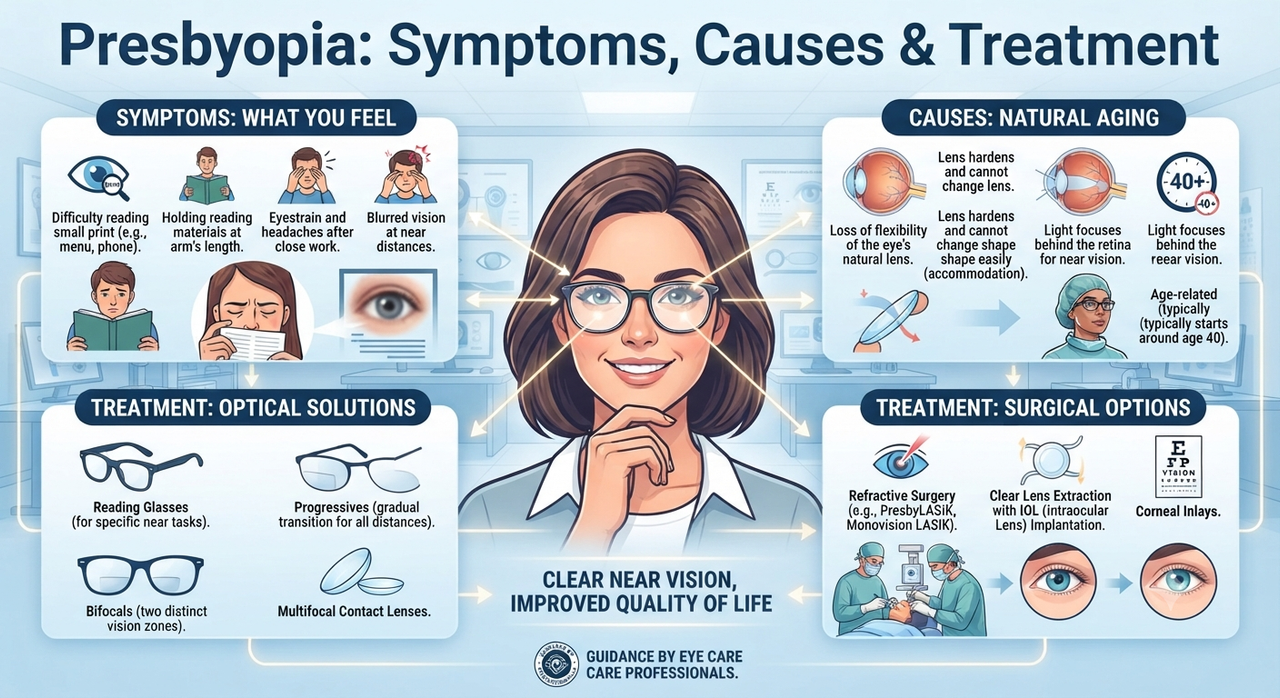
Presbyopia after 40 is one of the most common age-related vision changes. Many people who have enjoyed clear near vision for most of their lives suddenly notice that reading small print has become difficult, their smartphone needs to be held farther away, or their eyes feel tired after reading.
This change can be surprising, especially when distance vision remains clear. However, difficulty with near vision after the age of 40 is often a normal consequence of the gradual reduction in the eye's ability to accommodate.
Presbyopia is not the same as myopia, hypermetropia, or cataract. It is primarily an age-related loss of accommodation, caused by changes in the crystalline lens and the accommodative system.
The good news is that presbyopia can usually be managed very effectively with reading glasses, bifocals, progressive lenses, contact lenses, or selected surgical options.
What Is Presbyopia?
Presbyopia is the age-related reduction in the eye's ability to focus clearly on nearby objects.
To understand why near vision becomes blurry after 40, it is important to understand accommodation.
When looking at a distant object, the crystalline lens remains relatively flat.
When looking at a near object:
- The ciliary muscle contracts.
- Zonular tension decreases.
- The crystalline lens becomes more rounded.
- Lens power increases.
- The eye focuses the near object onto the retina.
This ability to increase lens power is called accommodation.
With age, the crystalline lens becomes progressively less flexible. As a result, it cannot change shape sufficiently to provide the optical power required for near vision.
Why Does Near Vision Become Blurry After 40?
The main reason is the progressive reduction in accommodative ability.
A young eye has a large accommodative reserve. When a young person looks at a nearby object, the crystalline lens can become significantly more convex.
After approximately 40 years of age, the lens gradually becomes less elastic and less capable of changing its shape.
Therefore:
Age-related lens changes → reduced accommodation → insufficient near focusing power → blurred near vision
This is the basic mechanism behind presbyopia.
Why Does Presbyopia Usually Become Noticeable After 40?
The loss of accommodation begins much earlier in life, but the symptoms become clinically noticeable when the remaining accommodative reserve is no longer sufficient for normal near tasks.
In younger adults, the eye has more than enough accommodative ability.
As the accommodative amplitude decreases with age, the remaining reserve becomes progressively smaller.
Eventually, the person notices that ordinary reading distances require more focusing effort than the eye can comfortably provide.
This is why presbyopia commonly becomes noticeable around 40–45 years of age.
What Happens to the Crystalline Lens With Age?
The crystalline lens plays a central role in accommodation.
Throughout life, the lens undergoes gradual structural changes.
With aging:
- The lens becomes less elastic.
- Lens fibers become increasingly compact.
- Lens rigidity increases.
- The ability to change lens curvature decreases.
- Accommodative amplitude progressively falls.
The lens therefore becomes less capable of becoming sufficiently convex during near focusing.
What Is Accommodation?
Accommodation is the process by which the eye changes its optical power to focus on objects at different distances.
For distance vision
The accommodative system is relatively relaxed, and the lens is relatively flat.
For near vision
The accommodative system becomes active and the lens becomes more convex.
The increased lens curvature provides additional refractive power.
In presbyopia, this process becomes increasingly limited.
The Near Triad
Near vision involves three coordinated responses:
1. Accommodation
The crystalline lens increases its optical power.
2. Convergence
Both eyes rotate inward toward the near target.
3. Pupillary constriction
The pupil becomes smaller.
These three responses are collectively known as the near triad.
Presbyopia primarily involves the loss of effective accommodation, although the overall near visual response is more complex.
What Is Accommodative Amplitude?
Accommodative amplitude is the maximum amount of additional optical power that the eye can generate through accommodation.
It is expressed in diopters (D).
Accommodative amplitude is relatively high in childhood and young adulthood.
It gradually decreases throughout life.
When the available accommodative amplitude becomes insufficient for comfortable near work, symptoms of presbyopia become apparent.
What Happens to the Near Point With Age?
The near point is the closest point at which an object can be seen clearly with maximum accommodation.
In a young person, the near point may be very close to the eye.
As accommodation decreases:
Near point moves farther away.
This explains why a person with presbyopia may hold a book or smartphone farther away to see it clearly.
Why Do People Hold Books Farther Away?
This is one of the classic signs of presbyopia.
A close object requires greater accommodative effort.
If the eye cannot generate enough accommodative power, the object appears blurred.
Moving the object farther away reduces the accommodative demand.
The patient therefore naturally increases the working distance.
This behavior is sometimes called "long-arm syndrome."
Common Symptoms of Presbyopia After 40
Presbyopia usually develops gradually.
Common symptoms include:
1. Blurred Near Vision
Small text may appear unclear, particularly at normal reading distances.
2. Difficulty Reading Small Print
Patients may struggle with:
- Books
- Newspapers
- Menus
- Medicine labels
- Product packaging
3. Holding Reading Material Farther Away
Patients often move reading material farther from their eyes.
4. Eye Strain
Extended near work may cause ocular fatigue.
5. Headaches
Prolonged effort to maintain near focus can contribute to headaches.
6. Difficulty in Dim Light
Near tasks may become particularly difficult under poor illumination.
7. Difficulty Using Smartphones
Small text and close viewing distances can make presbyopia more noticeable.
8. Need for Larger Text
Patients may increase font size on smartphones, tablets, or computers.
Why Is Reading Easier in Bright Light?
Many people with early presbyopia notice that they can read more comfortably in bright light.
One reason is that brighter illumination causes the pupil to constrict.
A smaller pupil can increase depth of focus and reduce the effect of small focusing errors.
Therefore, a presbyopic patient may say:
"I can read comfortably in daylight, but I struggle to read at night."
This is a common early complaint.
Presbyopia and Smartphone Use
Smartphones are used at relatively close distances, making them an excellent way to notice emerging presbyopia.
A person may notice:
- Blurred phone text
- Eye fatigue
- Difficulty reading messages
- Holding the phone farther away
- Increasing font size
- Taking frequent breaks
Smartphone use does not cause presbyopia.
Instead, it makes an existing reduction in near focusing ability more noticeable.
Presbyopia and Computer Work
Computer screens are generally positioned farther away than books or smartphones.
Therefore, computer work often requires intermediate vision rather than very close near vision.
People with presbyopia may experience difficulty switching between:
- Computer screen
- Documents
- Smartphone
- Distant objects
Occupational or computer-specific lenses can sometimes provide a more suitable correction than standard reading glasses.
Presbyopia in People With Normal Distance Vision
One of the most confusing aspects of presbyopia is that distance vision may remain completely clear.
For example:
A 45-year-old person may be able to see road signs and television clearly but struggle to read a newspaper.
This happens because presbyopia primarily affects near focusing, not distance vision.
If the person is otherwise emmetropic, distance glasses may not be necessary.
A near addition may be sufficient.
Presbyopia in Myopic Patients
Myopic patients also develop presbyopia.
However, a myopic person may sometimes read without their distance glasses.
For example, removing distance spectacles may allow a myopic patient to see near objects comfortably because the eye's uncorrected focal point is already closer than infinity.
This does not mean that the patient has avoided presbyopia.
The age-related reduction in accommodation still occurs.
Presbyopia in Hypermetropic Patients
Hypermetropic patients may experience near difficulties more noticeably.
A hypermetropic eye may use accommodation to compensate for its refractive error.
As accommodation declines with age, the ability to compensate becomes weaker.
Therefore:
Hypermetropia + age-related loss of accommodation = increased near-vision difficulty
This is why some hypermetropic patients may become symptomatic earlier or experience more significant near discomfort.
Presbyopia vs Hypermetropia
These conditions are often confused because both may require plus lenses.
However:
Presbyopia
Age-related loss of accommodation
Hypermetropia
Refractive error due to insufficient optical power relative to the eye's axial length and other optical factors
A person can have:
- Presbyopia alone
- Hypermetropia alone
- Both hypermetropia and presbyopia
Presbyopia vs Myopia
Myopia and presbyopia are also different.
Myopia
The eye focuses distant parallel rays in front of the retina when accommodation is relaxed.
Presbyopia
The eye cannot generate sufficient additional optical power for near focusing because accommodative ability has declined.
A person can therefore have both conditions.
Presbyopia vs Cataract
Not all blurred vision after 40 is presbyopia.
Cataract is a different condition involving opacity of the crystalline lens.
Presbyopia
- Primarily affects near vision
- Related to loss of accommodation
- Corrected optically with near addition
Cataract
- Causes lens opacity
- May affect distance and near vision
- Can cause glare
- May reduce contrast
- May eventually require surgery
If vision becomes cloudy, significantly reduced, or distorted, an eye examination is important.
How Is Presbyopia Diagnosed?
Presbyopia is generally diagnosed during a comprehensive eye examination.
1. Distance Visual Acuity
Distance vision is assessed using an appropriate visual acuity chart.
2. Near Visual Acuity
The patient's ability to read near targets at a standardized working distance is assessed.
3. Refraction
The distance refractive error is determined.
4. Near Addition
An appropriate plus addition is determined according to the patient's needs.
5. Accommodation Assessment
Accommodative function may be assessed when clinically indicated.
6. Ocular Examination
The eye should be examined to rule out other causes of visual symptoms.
How Is Presbyopia Managed?
There is no single treatment that is ideal for everyone.
Management depends on:
- Age
- Distance prescription
- Near working distance
- Occupation
- Lifestyle
- Ocular health
- Visual requirements
- Patient preference
The major options include:
- Reading glasses
- Bifocal lenses
- Progressive lenses
- Occupational lenses
- Multifocal contact lenses
- Monovision
- Surgical options
1. Reading Glasses
Reading glasses are the simplest treatment for many people with presbyopia.
They provide additional plus power for near vision.
They are particularly suitable for people who:
- Have good distance vision
- Only need help with near tasks
- Prefer a simple solution
- Do not want contact lenses or surgery
2. Bifocal Glasses
Bifocals contain two different optical zones.
Typically:
- Upper portion → distance
- Lower portion → near
They are useful for patients who need both distance and near correction.
3. Progressive Addition Lenses
Progressive lenses provide a gradual transition between distance, intermediate, and near vision.
They do not have the visible dividing line found in conventional bifocals.
They are often useful for people who frequently change between different viewing distances.
4. Occupational Lenses
Occupational lenses are designed around specific working distances.
They can be useful for:
- Computer users
- Office workers
- Dentists
- Laboratory professionals
- Artists
- People performing detailed near tasks
5. Contact Lenses
Presbyopia can be managed using:
- Multifocal contact lenses
- Monovision contact lenses
- Selected modified monovision approaches
Contact lenses may reduce dependence on spectacles but require appropriate fitting and ongoing care.
6. Monovision
In monovision:
- One eye is corrected primarily for distance.
- The other eye is corrected primarily for near.
The brain learns to use the appropriate eye depending on the visual task.
Not everyone adapts equally well.
Potential limitations include reduced stereopsis and difficulties with certain low-contrast or night-vision tasks.
7. Surgical Options
Selected patients may consider surgical correction.
Depending on the individual's age, refractive status, lens condition, corneal health, and visual goals, options may include:
- Corneal refractive approaches
- Monovision procedures
- Lens-based surgery
- Presbyopia-correcting intraocular lenses
Surgery requires careful patient selection and counseling.
Can Presbyopia Be Prevented?
There is currently no established method to completely prevent normal age-related presbyopia.
However, good visual habits can improve comfort.
Helpful measures include:
- Adequate lighting
- Appropriate reading distance
- Regular breaks during prolonged near work
- Correct prescription
- Appropriate screen positioning
- Regular eye examinations
These measures support comfortable vision but do not stop the normal aging of the crystalline lens.
Can Eye Exercises Cure Presbyopia?
There is no proven eye exercise that can restore the age-related flexibility of the crystalline lens.
Exercises may be useful for certain accommodative or binocular vision problems, but they should not be considered a proven cure for normal age-related presbyopia.
Why Does Presbyopia Continue to Change With Age?
Presbyopia is not necessarily a one-time event.
Accommodation continues to decline with age.
Therefore, the near correction may need adjustment over time.
A person who initially needs a small near addition may require a stronger addition later.
This is why periodic eye examinations are useful.
Presbyopia and Working Distance
The required near correction depends partly on the working distance.
A closer working distance requires greater accommodative demand.
For example:
- Smartphone use → relatively close
- Book reading → near
- Computer work → intermediate
- Viewing across a room → distance
Therefore, a single pair of glasses may not always provide ideal vision for every task.
Presbyopia and Depth of Focus
Depth of focus refers to the range of object distances that can appear acceptably clear for a given optical system.
Pupil size influences depth of focus.
A smaller pupil generally increases depth of focus.
This is one reason why presbyopic patients may experience better near clarity under bright illumination.
When Should You Get an Eye Examination After 40?
People around or above 40 who notice new near-vision difficulty should consider a comprehensive eye examination.
An examination is especially important if there is:
- Sudden vision change
- Significant reduction in vision
- Eye pain
- Flashes
- New floaters
- Distortion
- Double vision
- Marked difference between the eyes
- Persistent headaches
- Difficulty seeing despite corrective lenses
These symptoms may indicate conditions other than presbyopia.
Frequently Asked Questions About Presbyopia After 40
Is blurry near vision after 40 normal?
Gradual difficulty with near vision around 40–45 years is commonly caused by presbyopia. However, a complete eye examination is useful to confirm the cause and rule out other eye problems.
Why can I see far away but not read my phone?
Distance vision requires little accommodation, while near vision requires additional focusing power. Presbyopia reduces this ability.
Why do I need to hold my phone farther away?
Moving the phone farther away decreases the accommodative demand and may make the image clearer.
Do I need reading glasses after 40?
Not everyone needs them at exactly 40, but many people eventually require some form of near correction as accommodation declines.
Can presbyopia happen before 40?
The accommodative ability gradually declines before 40, but symptoms typically become clinically noticeable around 40–45 years.
Does presbyopia get worse with age?
The accommodative ability generally continues to decline with age, so the required near correction may change.
Can presbyopia be permanently cured?
Conventional glasses and contact lenses compensate for the problem. Selected surgical procedures can reduce spectacle dependence, but they do not necessarily restore the full accommodative function of a young eye.
Conclusion
Presbyopia after 40 is a common age-related change in near vision caused by the progressive reduction in accommodation. The crystalline lens becomes less flexible and less capable of increasing its optical power for near objects. As a result, small print becomes blurry, reading becomes more difficult, and people often begin holding books or smartphones farther away.
The condition usually develops gradually and can be effectively managed with reading glasses, bifocals, progressive lenses, occupational lenses, contact lenses, or selected surgical procedures.
The most important concept to remember is:
After 40, reduced lens flexibility → reduced accommodation → insufficient near focusing power → blurred near vision.
Presbyopia is a normal part of aging, but new or sudden changes in vision should never automatically be attributed to presbyopia. A comprehensive eye examination can confirm the diagnosis and ensure that other age-related eye conditions are not being overlooked.
By TheFutureMed Editorial Team
Status: Published