
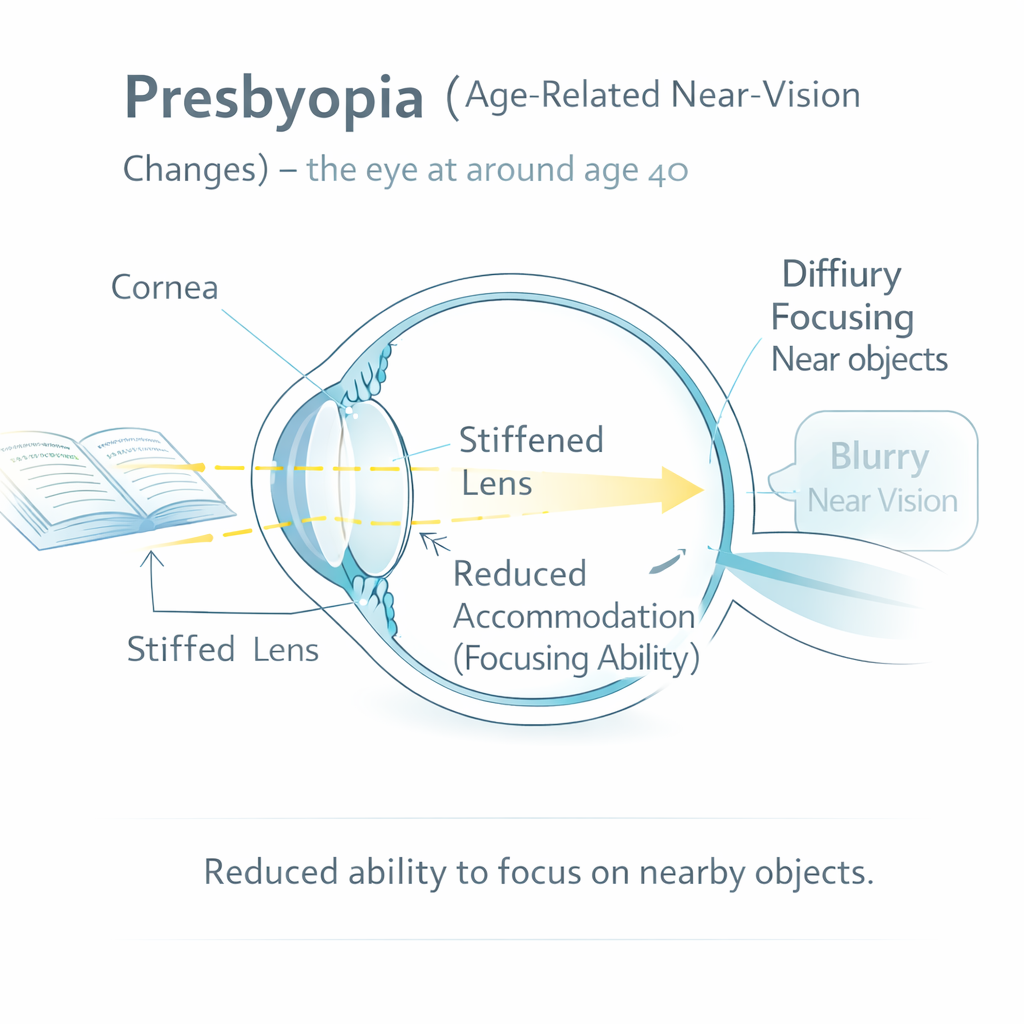
Presbyopia in Detail: Age-Related Loss of Near Vision and How It Develops
Presbyopia is one of the most common age-related changes affecting the visual system. It causes a gradual reduction in the ability to see and focus clearly on nearby objects. People who previously read comfortably without glasses may begin to notice blurred small print, eye strain, headaches, or the need to hold books and smartphones farther away.
Presbyopia is not simply a problem of "weak eyesight." It is primarily related to the progressive reduction in the eye's accommodative ability, particularly the age-related changes in the crystalline lens that make it increasingly difficult to increase optical power for near vision.
It usually becomes noticeable around 40–45 years of age, although the exact onset varies from person to person.
What Is Presbyopia?
Presbyopia is an age-related physiological loss of accommodation that reduces the ability of the eye to focus clearly on near objects.
To understand presbyopia, it is important to first understand accommodation.
When a young person looks at a distant object, the crystalline lens remains relatively flat. When the person shifts their gaze to a nearby object, the eye must increase its optical power.
This occurs through accommodation.
During accommodation:
- The ciliary muscle contracts.
- Zonular tension on the lens decreases.
- The crystalline lens becomes more rounded.
- Lens power increases.
- The near object can be focused on the retina.
With aging, this system becomes progressively less effective.
Why Does Presbyopia Develop?
Presbyopia develops primarily because of age-related changes in the crystalline lens and the accommodative system.
The most important change is the gradual loss of lens flexibility.
A young crystalline lens is relatively soft and elastic. It can change its shape when accommodation occurs.
As age increases, the lens becomes:
- Less elastic
- More rigid
- More compact
- Less capable of changing curvature
Therefore, even though the eye continues to receive the accommodative stimulus, the lens cannot increase its optical power sufficiently for near vision.
The Role of the Crystalline Lens in Presbyopia
The crystalline lens is a transparent, biconvex structure located behind the iris.
One of its major functions is to provide variable optical power.
Unlike the cornea, which provides relatively fixed refractive power, the crystalline lens can change its shape during accommodation.
In a young eye
The lens can become more convex during accommodation.
In an aging eye
The lens becomes progressively less deformable.
Therefore:
Less lens flexibility → reduced accommodative response → reduced near focusing ability → presbyopia
Understanding Accommodation
Accommodation allows the eye to focus on objects at different distances.
Accommodation for Near Vision
When looking at a nearby object, three important responses occur together:
1. Accommodation
The crystalline lens increases its optical power.
2. Convergence
Both eyes rotate inward to maintain binocular fixation on the near target.
3. Pupillary constriction
The pupils become smaller, improving depth of focus and reducing optical aberrations.
These three responses are commonly referred to as the near triad.
What Happens to Accommodation With Age?
The accommodative ability of the eye is not constant throughout life.
It is relatively high during childhood and early adulthood.
As age increases, accommodative amplitude progressively decreases.
A young adult can often accommodate strongly enough to focus on objects very close to the eyes.
However, with increasing age, the maximum available accommodation becomes progressively smaller.
Eventually, the eye cannot generate enough additional optical power to focus comfortably at normal reading distances.
This is when presbyopia becomes clinically noticeable.
Presbyopia and the Near Point
The near point of accommodation is the closest point at which an object can be clearly seen using maximum accommodation.
In young individuals, the near point can be very close to the eye.
With aging, the near point gradually moves farther away.
For example, a young person may comfortably focus on an object at a very short distance, while an older person may need to hold the same object farther away.
This progressive recession of the near point is a classic feature of presbyopia.
What Is Accommodative Amplitude?
Amplitude of accommodation is the maximum amount by which the eye can increase its optical power through accommodation.
It is expressed in diopters (D).
The accommodative amplitude is high in young individuals and progressively decreases with age.
A simplified relationship is:
Amplitude of accommodation = 1 / near point (in meters)
For example, if the near point is 0.10 m:
Amplitude = 1 / 0.10 = 10 D
As the near point moves farther away, the available accommodative amplitude decreases.
How Does the Lens Change With Age?
The crystalline lens undergoes several structural changes throughout life.
Lens growth continues
The lens continues to grow throughout life, adding new lens fibers.
Increasing lens rigidity
The lens gradually becomes harder and less flexible.
Changes in lens proteins
Age-related biochemical changes affect the physical properties of the lens.
Reduced deformability
The lens becomes increasingly resistant to the shape changes required during accommodation.
These changes contribute significantly to the development of presbyopia.
Is the Ciliary Muscle Responsible for Presbyopia?
The ciliary muscle is an important component of accommodation, but presbyopia cannot be explained simply as "the ciliary muscle becoming weak."
The development of presbyopia involves multiple age-related changes in the accommodative apparatus.
These include changes involving:
- Crystalline lens
- Lens capsule
- Zonular apparatus
- Ciliary body
- Vitreous and surrounding structures
The loss of lens elasticity and reduced ability of the lens to change shape are particularly important factors.
This is one of the most recognizable symptoms of presbyopia.
When an object is very close to the eye, it requires a large amount of accommodation.
As accommodation decreases with age, the patient may not have enough accommodative power to focus at that close distance.
Moving the object farther away reduces the accommodative demand.
Therefore, a presbyopic patient may naturally hold:
- Books farther away
- Newspapers farther away
- Smartphones farther away
- Menus farther away
This is sometimes called the "long-arm syndrome."
Early Symptoms of Presbyopia
Presbyopia usually develops gradually.
Early symptoms may include:
Difficulty reading small print
Small letters become increasingly difficult to distinguish.
Need for brighter illumination
Patients may find that reading becomes easier under brighter light.
Eye strain
Near work may become uncomfortable after prolonged periods.
Headaches
Sustained near focusing effort can contribute to headaches.
Blurred near vision
The most characteristic symptom is difficulty maintaining clear near focus.
Increasing working distance
Patients may unconsciously move reading material farther away.
Why Is Presbyopia Worse in Dim Light?
Many presbyopic patients notice that reading becomes more difficult in poor illumination.
Several factors contribute.
Under brighter illumination, pupil size tends to become smaller.
A smaller pupil increases depth of focus and can improve the apparent clarity of near objects.
In dim light, the pupil becomes larger, reducing depth of focus and making the effects of inadequate accommodation more noticeable.
Therefore, a patient may say:
"I can read better during the day than at night."
Presbyopia and Smartphone Use
Smartphones have made near vision particularly important in modern life.
People frequently view their phones at relatively close distances.
For someone developing presbyopia, prolonged smartphone use may reveal symptoms such as:
- Blurred text
- Eye fatigue
- Difficulty focusing
- Headaches
- Need to increase font size
- Holding the phone farther away
The smartphone itself does not cause presbyopia. Instead, close digital tasks can make an existing age-related reduction in accommodation more noticeable.
Presbyopia and Reading
Reading is one of the activities in which presbyopia is usually noticed first.
A person may suddenly find that:
- Small print is difficult
- Reading becomes tiring
- They need brighter light
- They need to increase font size
- They need to move the book farther away
- They cannot sustain reading for long periods
These symptoms typically develop progressively rather than appearing suddenly.
Presbyopia in Myopic Patients
Myopic patients also develop presbyopia.
However, their symptoms may appear different.
A myopic patient may remove their distance spectacles and read comfortably at near.
This happens because the uncorrected myopic eye has a natural far point that is closer than infinity.
For example, a person with moderate myopia may be able to see near objects without using accommodation as much as an emmetrope.
Therefore, myopic patients sometimes feel that they have "escaped" presbyopia.
They have not.
The age-related loss of accommodation still occurs.
Presbyopia in Hypermetropic Patients
Hypermetropic patients may become symptomatic earlier because accommodation may already be required to compensate for some of their hypermetropia.
When accommodative reserve decreases with age, maintaining clear vision becomes more difficult.
Therefore:
Hypermetropia + declining accommodation = earlier or more noticeable near-vision difficulty in many patients.
Presbyopia in Emmetropia
An emmetropic person has little or no refractive error for distance.
In young adulthood, they can generally see distant and near objects clearly without corrective lenses.
As accommodation decreases with age, near vision becomes progressively blurred.
They may continue to have good distance vision but require plus-powered reading correction.
Presbyopia vs Myopia
Presbyopia and myopia have different mechanisms.
Myopia
In myopia, parallel rays from distant objects are focused in front of the retina when accommodation is relaxed.
Presbyopia
In presbyopia, the eye cannot generate sufficient additional power for near focusing because accommodative ability has declined.
A person can therefore have both myopia and presbyopia.
Presbyopia vs Hypermetropia
Both conditions may require plus lenses, but they are fundamentally different.
Hypermetropia is a refractive condition related to the optical and anatomical properties of the eye.
Presbyopia is an age-related reduction in accommodation.
Therefore:
Plus lens does not automatically mean presbyopia.
This is an important clinical and examination point.
How Is Presbyopia Diagnosed?
Presbyopia is usually identified during a comprehensive eye examination.
The evaluation may include:
1. Distance Visual Acuity
Distance vision is assessed using an appropriate visual acuity chart.
2. Near Visual Acuity
The patient reads standardized near-print material at a specified working distance.
3. Refraction
The examiner determines the patient's distance refractive correction.
4. Near Addition
A suitable plus addition is determined based on the patient's near requirements.
5. Accommodation Assessment
Accommodative function may be assessed when clinically indicated.
6. Binocular Vision Assessment
Binocular function can be considered, especially when symptoms are disproportionate to the refractive findings.
How Is Presbyopia Corrected?
The most common treatment is optical correction with plus power for near vision.
Available options include:
Reading glasses
Used primarily for near tasks.
Bifocal glasses
Provide distance and near correction in different portions of the lens.
Progressive addition lenses
Provide a gradual transition between distance, intermediate, and near vision.
Occupational lenses
Designed for specific working distances, such as computer-based work.
Multifocal contact lenses
Provide simultaneous or alternative optical correction for multiple distances.
Monovision
One eye is corrected primarily for distance and the other for near.
Surgical approaches
Selected patients may undergo procedures designed to reduce dependence on glasses.
Why Are Plus Lenses Used for Presbyopia?
Near objects require the eye to provide additional optical power.
When accommodation becomes insufficient, an additional plus lens supplies some of the optical power that the eye can no longer generate adequately.
This reduces the accommodative demand required for near work.
For example, a patient who cannot comfortably sustain near focus may be given an appropriate near addition.
Can Presbyopia Be Prevented?
At present, there is no established method to completely prevent the normal age-related loss of accommodation.
Healthy visual habits are still important for overall eye comfort and ocular health.
These include:
- Adequate lighting
- Appropriate reading distance
- Regular breaks during prolonged near work
- Correct spectacle prescription
- Regular eye examinations
- Management of associated eye conditions
However, these measures do not stop the normal age-related changes of the crystalline lens.
Can Eye Exercises Reverse Presbyopia?
Eye exercises cannot restore the youthful elasticity of the crystalline lens.
Exercises may have a role in selected accommodative or binocular vision disorders, but they should not be presented as a proven cure for age-related presbyopia.
Presbyopia and Cataract
Presbyopia and cataract are different conditions.
Presbyopia
- Mainly affects near focusing
- Caused by age-related loss of accommodation
- Correctable with near optical addition
Cataract
- Involves opacity of the crystalline lens
- Can affect distance and near vision
- May cause glare and reduced contrast
- Can eventually require cataract surgery
Both conditions can occur in the same person because both become common with increasing age.
Presbyopia and Age-Related Eye Diseases
Not every visual problem after 40 is presbyopia.
Other conditions can affect vision, including:
- Cataract
- Glaucoma
- Age-related macular degeneration
- Diabetic eye disease
- Corneal disorders
- Retinal disease
Therefore, persistent, unusual, or sudden changes in vision should be evaluated rather than automatically attributed to presbyopia.
Clinical Importance of Presbyopia
Presbyopia has an important effect on everyday activities and occupational performance.
It may interfere with:
- Reading
- Writing
- Driving-related near tasks
- Computer work
- Mobile phone use
- Needlework
- Laboratory work
- Fine manual activities
- Professional work requiring detailed near vision
Correct near correction can significantly improve visual comfort and quality of life.
Presbyopia: Important Exam Points
- Presbyopia is an age-related loss of accommodation.
- It commonly becomes noticeable around 40–45 years.
- The crystalline lens becomes progressively less elastic.
- Accommodative amplitude decreases with age.
- The near point moves farther away.
- Patients experience blurred near vision.
- Holding reading material farther away is a classic complaint.
- Poor illumination can make symptoms more noticeable.
- Plus lenses are used to compensate for reduced near focusing ability.
- Presbyopia can occur in myopes, hypermetropes, and emmetropes.
- Presbyopia is different from hypermetropia.
- Presbyopia is a physiological age-related change, although its symptoms may require correction.
Frequently Asked Questions About Presbyopia
What is the main cause of presbyopia?
The primary cause is the age-related reduction in the eye's ability to accommodate, particularly due to progressive changes in the crystalline lens.
Does presbyopia occur only after 40?
It commonly becomes noticeable around 40–45 years, but the exact age varies.
Why does near vision become blurry in presbyopia?
The eye cannot increase its optical power sufficiently to focus near objects on the retina.
Why do presbyopic patients need plus lenses?
A plus lens supplies additional optical power and reduces the accommodative demand for near work.
Does presbyopia affect distance vision?
Presbyopia primarily affects near vision. Distance vision can remain clear if there is no other refractive error or ocular disease.
Can a person have both myopia and presbyopia?
Yes. Myopia does not prevent the age-related loss of accommodation.
Does using a smartphone cause presbyopia?
No. Smartphone use does not cause the age-related loss of accommodation, although prolonged near work can make symptoms more noticeable.
Can presbyopia be cured naturally?
There is currently no proven natural method that reverses the age-related loss of lens flexibility.
Conclusion
Presbyopia is a progressive, age-related reduction in the eye's ability to focus on near objects. It develops as the accommodative system becomes less capable of providing the additional optical power required for near vision, with age-related changes in the crystalline lens playing a major role.
The condition usually becomes noticeable around 40–45 years of age and may initially present as difficulty reading small print, eye strain, headaches, increased working distance, and difficulty seeing clearly in dim light.
Understanding presbyopia requires a clear understanding of accommodation, accommodative amplitude, the crystalline lens, near point, and the near triad. Although presbyopia is a normal part of aging, its effects can be effectively managed with reading glasses, bifocals, progressive lenses, occupational lenses, contact lenses, or selected surgical approaches.
For students and eye-care professionals, the key concept is simple:
Presbyopia = age-related reduction in accommodation → reduced near focusing ability → blurred near vision → need for additional plus power.