
Why Accurate Pupillary Distance Is Essential for Clear Vision
Why Accurate Pupillary Distance Is Essential for Clear Vision
Primary Keywords: accurate pupillary distance, incorrect PD symptoms
Secondary Keywords: pupillary distance accuracy, optical center alignment, incorrect pupillary distance, PD measurement, blurry vision with new glasses, eye strain from glasses, progressive lens fitting
Title: Why Accurate Pupillary Distance Is Essential for Clear Vision | Complete Guide
Description: Learn why accurate pupillary distance (PD) is essential for clear vision. Discover how incorrect PD affects optical center alignment, causes eye strain, headaches, blurred vision, and adaptation problems with progressive lenses.
Introduction
When people receive a new pair of prescription glasses and experience blurred vision, headaches, or discomfort, they often assume the prescription is incorrect. However, in many cases, the problem isn't the lens power—it's an inaccurate Pupillary Distance (PD) measurement.
Pupillary Distance (PD) is one of the most important measurements in eyewear fitting. It ensures that the optical center of each lens aligns perfectly with the center of your pupils. Even a perfectly written prescription can fail to provide clear vision if the PD is measured incorrectly.
Whether you wear single-vision lenses, bifocals, progressive lenses, or high-prescription eyewear, accurate PD is essential for comfortable vision and optimal lens performance.
In this comprehensive guide, you'll learn why accurate pupillary distance matters, how incorrect PD affects your vision, the symptoms to watch for, and why precise PD is especially important for progressive lenses.
What Is Pupillary Distance (PD)?
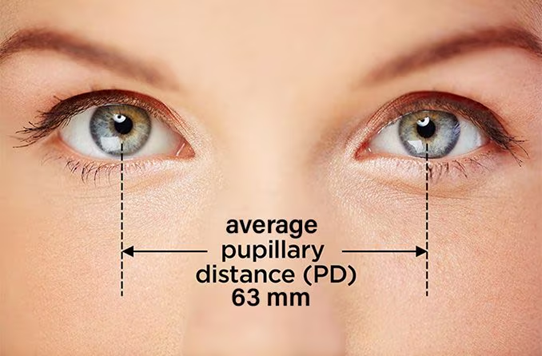
Pupillary Distance (PD) is the distance between the centers of your pupils, measured in millimeters (mm).
This measurement allows the optical laboratory to position the optical center of each lens directly in front of your eyes. Proper alignment ensures that light passes through the intended part of the lens, delivering the clearest possible vision.
PD is usually measured as:
- Distance PD – Used for everyday and distance vision.
- Near PD – Used for reading and close work.
- Monocular PD – Individual measurement for each eye, commonly used for progressive lenses and high prescriptions.
Why Is Accurate Pupillary Distance So Important?
Think of your eyeglass lenses as precisely engineered optical instruments. Every lens has a specific point called the optical center, where light passes through with minimal distortion.
When your pupils align perfectly with these optical centers, your glasses perform exactly as intended.
However, if the optical centers are shifted because of an inaccurate PD measurement, your eyes must constantly compensate. This extra effort can reduce visual comfort and affect the overall effectiveness of your prescription.
Accurate PD ensures:
- Maximum visual clarity
- Comfortable binocular vision
- Proper lens performance
- Reduced eye fatigue
- Better adaptation to new glasses
Understanding Optical Center Alignment
What Is the Optical Center?
The optical center is the point on a lens where light passes without inducing unwanted prism.
It is carefully positioned during lens manufacturing according to your PD measurement.
When the optical center aligns with your pupil:
- Images appear sharper.
- Eye muscles remain relaxed.
- Vision feels natural.
- The prescription works as intended.
Why Optical Center Alignment Matters
Every prescription lens is designed around its optical center.
If this point is misplaced:
- Light rays enter the eye at an angle.
- The lens may create unintended prism effects.
- Your eyes must constantly adjust to maintain clear vision.
This compensation can become exhausting, especially during prolonged reading or computer work.
How Accurate PD Improves Vision
A correct PD measurement provides numerous visual benefits.
Sharp Vision
Proper lens alignment ensures that you view objects through the clearest part of the lens.
This improves:
- Reading clarity
- Distance vision
- Contrast sensitivity
- Depth perception
Comfortable Eye Movements
When both optical centers align correctly, your eyes move naturally together without excessive muscular effort.
This improves binocular coordination.
Reduced Visual Fatigue
Your eye muscles do not need to compensate for lens misalignment, reducing fatigue throughout the day.
Better Peripheral Vision
Properly centered lenses minimize peripheral distortion and improve overall visual quality.
What Happens If Your PD Is Incorrect?
Even a small PD error can produce noticeable symptoms.
The severity depends on:
- Lens power
- Lens type
- Amount of PD error
- Individual sensitivity
Higher prescriptions amplify the effects of inaccurate PD.
Effects of Incorrect Pupillary Distance
Unwanted Prism Effect
Incorrect PD shifts the optical center away from the pupil.
This creates unwanted prism, causing images to appear slightly displaced.
The brain attempts to compensate, increasing visual effort.
Reduced Visual Clarity
Even though the prescription is correct, vision may appear:
- Slightly blurry
- Distorted
- Less sharp than expected
Poor Binocular Vision
If each eye receives images from improperly aligned lenses, the brain struggles to fuse them into a single clear image.
This may result in:
- Double vision
- Difficulty focusing
- Reduced depth perception
Increased Eye Muscle Work
Your eye muscles constantly attempt to compensate for lens misalignment.
This continuous effort leads to visual fatigue.
Common Symptoms of Incorrect PD
Many symptoms resemble those caused by an incorrect prescription.
Common complaints include:
Eye Strain
One of the earliest signs of inaccurate PD.
Symptoms include:
- Tired eyes
- Difficulty concentrating
- Heavy eyelids
- Visual fatigue after reading
Headaches
Persistent headaches commonly develop because the eye muscles remain under continuous stress.
Headaches often worsen:
- After computer use
- While reading
- During driving
- At the end of the day
Blurred Vision
Vision may appear:
- Slightly out of focus
- Clear in one eye but not both
- Sharp only when turning the head
Blurred vision often improves temporarily when glasses are removed.
Double Vision
Incorrect lens alignment may interfere with binocular vision, producing intermittent double vision.
This is more common with higher prescriptions.
Dizziness
Some individuals experience:
- Lightheadedness
- Poor balance
- Motion sensitivity
- Feeling "off"
These symptoms occur because the visual system struggles to interpret distorted images.
Difficulty Focusing
Patients may report:
- Frequent blinking
- Constant refocusing
- Difficulty shifting focus between near and far objects
Eye Strain and Headaches: Why They Occur
The human visual system naturally tries to keep both eyes focused on the same target.
When PD is inaccurate:
- Eye muscles work harder.
- Extra convergence effort is required.
- The brain constantly corrects image alignment.
After hours of compensation, symptoms such as:
- Eye fatigue
- Forehead pain
- Temple headaches
- Neck discomfort
may develop.
These symptoms often disappear after correcting the PD.
Why Blurred Vision Occurs
Blurred vision from incorrect PD differs from blurred vision caused by an incorrect prescription.
With incorrect PD:
- The prescription itself is correct.
- Images are blurred because light passes through the wrong part of the lens.
- Tilting the head may temporarily improve clarity.
Patients often describe the vision as:
- "Almost clear"
- "Slightly distorted"
- "Not as sharp as my old glasses"
Why Progressive Lenses Require Extremely Accurate PD
Progressive lenses are among the most technically demanding prescription lenses.
Unlike single-vision lenses, progressive lenses contain three viewing zones:
- Distance vision
- Intermediate vision
- Near vision
Each zone occupies a specific location within the lens.
Even a 1–2 mm PD error can shift these viewing zones away from the wearer's natural line of sight.
Adaptation Issues with Progressive Lenses
Many patients require a short adaptation period when wearing progressive lenses.
However, incorrect PD can make adaptation far more difficult.
Common problems include:
- Difficulty reading
- Blurred intermediate vision
- Distorted side vision
- "Swimming" sensation
- Feeling off balance
- Frequent head movements to find clear vision
If these symptoms persist beyond a couple of weeks, the PD and other fitting measurements should be re-evaluated.
Why Monocular PD Is Important for Progressive Lenses
Progressive lenses are usually fitted using monocular PD rather than total binocular PD.
Monocular PD measures:
- Right eye individually
- Left eye individually
This allows precise positioning of each progressive corridor.
It is especially valuable when:
- The nose is not perfectly centered.
- One eye sits slightly higher than the other.
- Facial symmetry varies.
Who Is Most Affected by Incorrect PD?
Certain individuals are more sensitive to PD errors.
These include:
People with High Prescriptions
The stronger the lens, the greater the effect of even minor PD inaccuracies.
Progressive Lens Wearers
Precise alignment is essential for comfortable adaptation.
Children
Children may struggle to describe visual discomfort, making accurate measurements especially important.
Computer Users
Long hours of screen time increase the likelihood of noticing eye strain caused by incorrect PD.
Older Adults
Those using multifocal or progressive lenses rely heavily on accurate fitting measurements.
Can Incorrect PD Damage Your Eyes?
No. An incorrect PD does not cause permanent damage to the eyes.
However, it can significantly reduce visual comfort and quality of life.
Persistent symptoms may include:
- Headaches
- Blurred vision
- Eye strain
- Fatigue
- Reduced productivity
Correcting the PD usually resolves these issues.
How Optometrists Ensure Accurate PD
Eye care professionals use several methods to obtain precise measurements.
Manual PD Ruler
A millimeter ruler is aligned with the patient's pupils while they focus on a target.
Digital Pupillometer
An electronic device measures:
- Distance PD
- Near PD
- Monocular PD
Digital instruments offer greater accuracy and consistency.
Frame-Specific Measurements
For premium lenses, additional fitting parameters may include:
- Fitting height
- Vertex distance
- Pantoscopic tilt
- Frame wrap angle
These measurements help optimize lens performance.
Tips to Ensure Accurate PD
To maximize the performance of your glasses:
- Have your PD measured by an eye care professional.
- Verify measurements before ordering glasses online.
- Recheck PD if new glasses feel uncomfortable.
- Use monocular PD for progressive or high-power lenses.
- Choose experienced optical professionals for premium eyewear.
Frequently Asked Questions
Can incorrect PD make new glasses blurry?
Yes. Even with the correct prescription, an inaccurate PD can cause blurred or distorted vision because the optical centers are not properly aligned.
How much PD error is acceptable?
Small variations may be tolerated in low prescriptions, but even 1–2 mm of error can significantly affect comfort and vision in high prescriptions or progressive lenses.
Why do I get headaches with my new glasses?
Headaches may occur if your eyes are constantly compensating for an incorrect PD, forcing the eye muscles to work harder.
Is PD important for all types of glasses?
Yes. Accurate PD is important for single-vision, reading, bifocal, and progressive lenses. It becomes increasingly critical as prescription strength and lens complexity increase.
Can I measure my PD at home?
Home measurements can be useful for simple single-vision glasses, but professional measurements are recommended for progressive lenses, prism prescriptions, and high-power lenses.
Conclusion
An accurate Pupillary Distance (PD) measurement is just as important as your eyeglass prescription. It ensures that the optical center of each lens aligns perfectly with your pupils, providing sharp vision, comfortable eye movements, and reduced visual strain.
When PD is incorrect, even the most precise prescription can lead to blurred vision, headaches, dizziness, and eye fatigue. These problems are especially noticeable with high prescriptions and progressive lenses, where precise optical alignment is essential.
Whether you're purchasing glasses in person or online, never underestimate the importance of an accurate PD measurement. A properly measured PD helps your lenses perform as designed, enhances visual comfort, and supports a smoother adaptation to new eyewear—allowing you to enjoy clear, comfortable vision every day.
By Unknown Author
Status: Published